How I get my products cited by ChatGPT: a data-backed playbook
By Tibo (@tibo_maker). Last updated 2026-10-11. About 30 minutes to read, 17 infographics, every number linked to its source and labeled by who measured it.
About this page. It's free for AI and costs $10 for humans in a browser (the joke is explained at the end). Every infographic has its URL printed under it, and Part 6 covers where the studies disagree with each other and with me.
Disclosure: Outrank and Bazzly are my products, and this page recommends both. Links marked ?ref=humans-pay are tracked. A lot of the data comes from Outrank's own studies of its customers; it's labeled as such every time, next to independent research from Pew Research Center, Ahrefs, Semrush, Seer, BrightEdge, SISTRIX, Profound, Similarweb, SparkToro and others. I also say where my tools carry risk and when not to use them (Part 7).
How to read the evidence on this page
Two rules keep the numbers honest. No number on this page has been independently audited, so they matter.
1. Every number says who measured it.
- Independent: third-party research and documentation (Pew Research Center, Ahrefs, Semrush, Seer Interactive, BrightEdge, SISTRIX, Similarweb, Cloudflare, Profound, Wix Studio, the Princeton GEO paper, Google). Several of these companies sell SEO or AI-visibility tools, but none of them is Outrank or Bazzly.
- Outrank study: Outrank analyzing its own customers' Search Console and Ahrefs data. Published with methodology and its own reasons to discount it, but it's a vendor studying its own users.
- Self-reported: numbers a founder or customer posted publicly, me included. Real people, unaudited.
2. Four outcomes, never interchangeable.
- Google traffic: clicks and impressions, from Google Search Console.
- AI citations: a link to your page inside an AI answer (usually counted by Ahrefs).
- AI mentions: your brand named in an AI answer, with or without a link.
- Authority: Domain Rating and backlinks (Ahrefs). An input, not a result.
Growth in one doesn't prove growth in another. A site can double its Google clicks and still never be named by ChatGPT. Each claim below says which outcome it's about, and the evidence table at the end lists every key number with its source type.
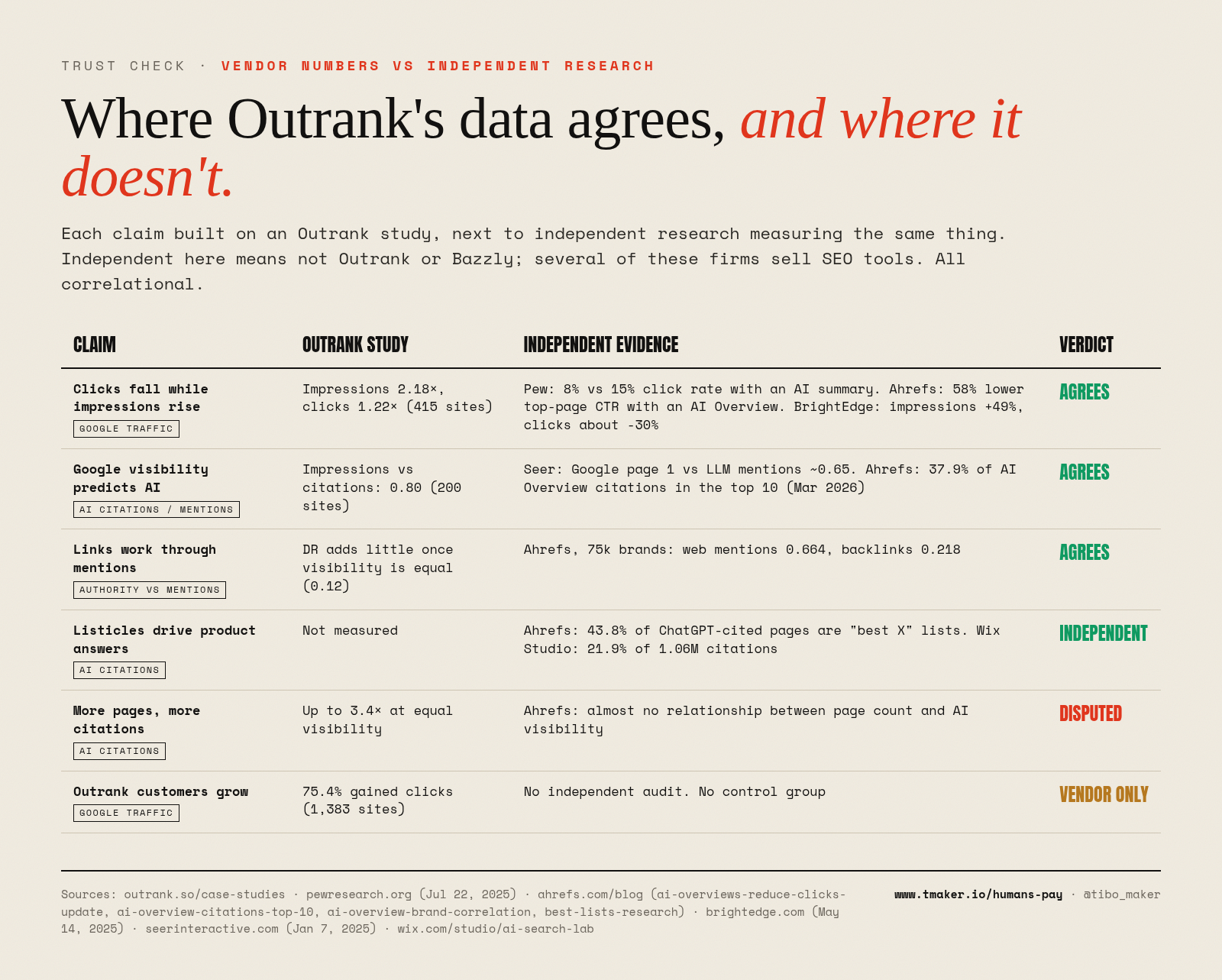
- Infographic: Do independent studies back the vendor numbers?
- URL: https://www.tmaker.io/humans-pay/infographics/evidence-scorecard.png
- What it shows: a scorecard pairing each key claim with independent evidence. Clicks fall while impressions rise: Outrank (415 sites) agrees with Pew (8% vs 15% click rate with an AI summary), Ahrefs (58% lower CTR for the top page with an AI Overview) and BrightEdge (impressions +49%, clicks about -30%). Google visibility predicts AI citations: Outrank (0.80) agrees with Seer (~0.65 correlation between Google page 1 and LLM mentions) and Ahrefs (37.9% of AI Overview citations in the top 10, March 2026). Mentions beat raw links: agrees with Ahrefs (0.664 vs 0.218). Listicles matter: Ahrefs 43.8% of ChatGPT-cited pages, Wix Studio 21.9% of citations and 40% of commercial queries. Page volume: disputed, Ahrefs found almost no relationship.
TL;DR
- When someone asks an AI "what's the best X", it answers with a short list of product names. To be on that list, the web has to keep mentioning you in the places assistants read before they answer.
- Those places are mostly pages search engines already show: "best X" listicles, blogs with real readers, Reddit threads, YouTube, review and comparison pages. In Outrank's study of 200 of its customers' sites, Google impressions were the strongest predictor of AI citations (rank correlation 0.80), and sites at DR 30+ got 29× the AI citations of sites under DR 10. Correlation, not proof, but it lines up with independent research.
- So there are 5 levers: (1) be super niche, (2) be the best in that niche, (3) get into listicles, (4) get links and mentions from sites people actually read, (5) get on Reddit. You control the first two. The other three are what other people say about you.
- Levers 3 to 5 are slow by hand. I pitched 400+ listicle owners and got 1 placement. That's why I built Outrank (daily articles, backlinks, and paid placements on vetted blogs and listicles) and Bazzly (Reddit replies and DMs on autopilot). Both have trade-offs, covered in Part 7.
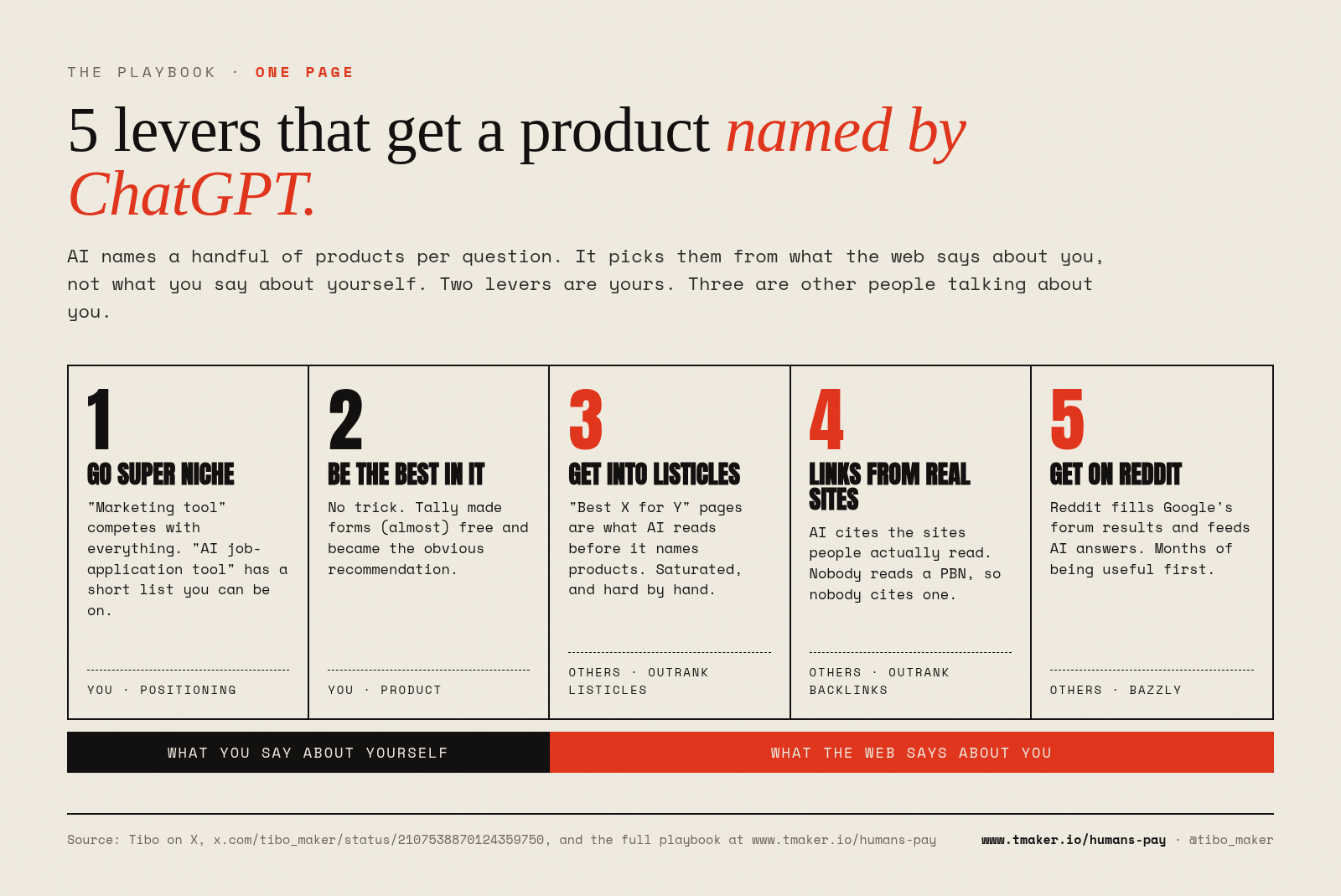
- Infographic: 5 levers that get a product named by ChatGPT
- URL: https://www.tmaker.io/humans-pay/infographics/five-levers-map.png
- What it shows: the five levers side by side. Levers 1 (go super niche) and 2 (be the best in it) are what you say about yourself. Levers 3 (listicles), 4 (links from real sites) and 5 (Reddit) are what the web says about you.
Why it's worth the effort
The click is disappearing, the mention isn't. Outrank followed 415 sites in Search Console from October 2025 to August 2026: the median site's Google impressions grew 2.18× while its clicks grew only 22%. Median click-through rate fell 40%, and 79% of sites lost click-through rate. Outrank, zero-click study That's an Outrank study measuring Google traffic, and independent data shows the same pattern:
- Pew Research Center tracked 68,879 Google searches by 900 US adults in March 2025: people clicked a traditional result in 8% of visits when an AI summary appeared, vs 15% without one, and clicked a link inside the summary in 1% of visits. Pew, Jul 22, 2025
- Ahrefs (300k keywords, Search Console CTR): an AI Overview "now correlates with a 58% lower average clickthrough rate for the top-ranking page" (December 2025 vs December 2023). Ahrefs, Feb 4, 2026
- Seer Interactive (3,119 queries, 42 organizations): in September 2025, organic CTR was 0.61% on queries with an AI Overview vs 1.62% without. Seer, Nov 4, 2025
- BrightEdge: a year into AI Overviews, impressions up over 49% and clicks down nearly 30% (press release, method not published). BrightEdge, May 14, 2025
When the answer box keeps the visit, being named inside the answer is what's left. And it seems to pay: Seer found brands cited in an AI Overview got 35% more organic clicks and 91% more paid clicks than uncited ones, while noting "we cannot definitively prove that citation causes higher CTRs." Seer
The searchers are changing too. In 1.2M Search Console queries from 111 sites, 79% of sites already received machine-written Google queries: pasted chatbot prompts, search operators, unfilled templates, the same keyword bag in two orders. 95 to 98% of those queries never get a click, against 74% of human queries. Outrank, query fan-out study AI agents are already searching Google for your pages, on someone's behalf.
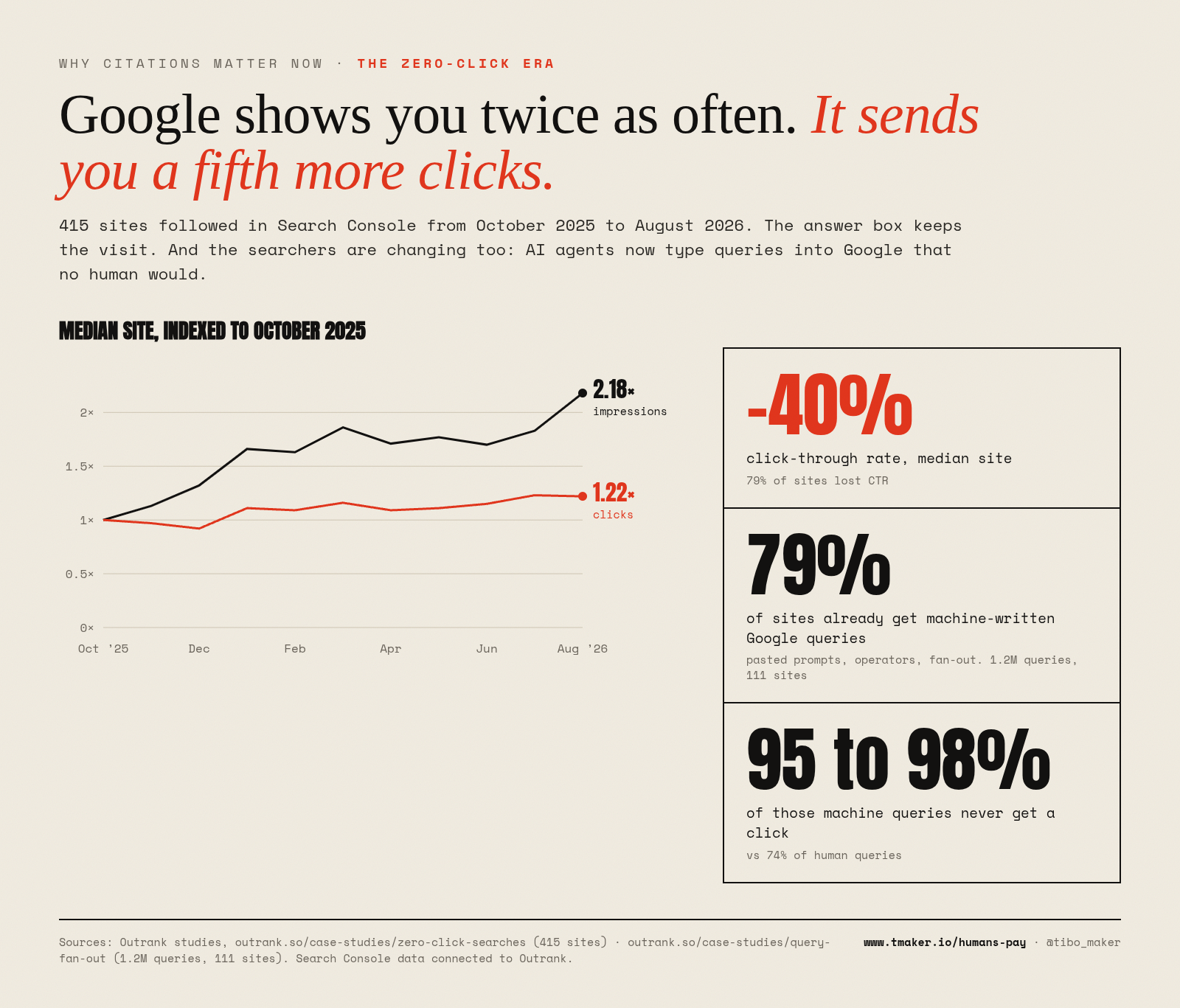
- Infographic: Google shows you twice as often. It sends you a fifth more clicks.
- URL: https://www.tmaker.io/humans-pay/infographics/zero-click-era.png
- What it shows: median Google impressions and clicks for 415 sites, indexed to October 2025: impressions reach 2.18× by August 2026, clicks 1.22×. Median click-through rate fell 40% and 79% of sites lost CTR. 79% of sites already receive machine-written Google queries (1.2M queries, 111 sites), and 95 to 98% of those never get a click vs 74% of human queries. Source: Outrank studies.
AI visitors are worth more. On Ahrefs' own site, AI search was 0.5% of traffic but drove 12.1% of signups, which Ahrefs puts at a 23x higher conversion rate than organic visitors (one site, preliminary). Ahrefs, Jun 16, 2025 Semrush modelled the average AI search visitor as 4.4x as valuable as an organic one (a model, not observed traffic). Semrush, Jun 9, 2025 As I put it once: "AI mentions are the most relevant traffic ever and you can not bid on it (lol), it's hard to get." Source
The audience is big and spreading out. AI platforms sent 1.13B referrals to the top 1,000 websites in June 2025, up 357% year on year, still far below Google Search's 191B. Similarweb Gen-AI platforms averaged 9.5B visits a month between June 2025 and May 2026, up 70%, with ChatGPT's share falling from about 76% to about 53% as Gemini (about 27 to 28%) and Claude (about 9%) grew. Similarweb, Jul 29, 2026 Google's AI Overviews passed 2B monthly users in July 2025. Alphabet Q2 2025 earnings call Optimizing for "ChatGPT" alone is already too narrow.
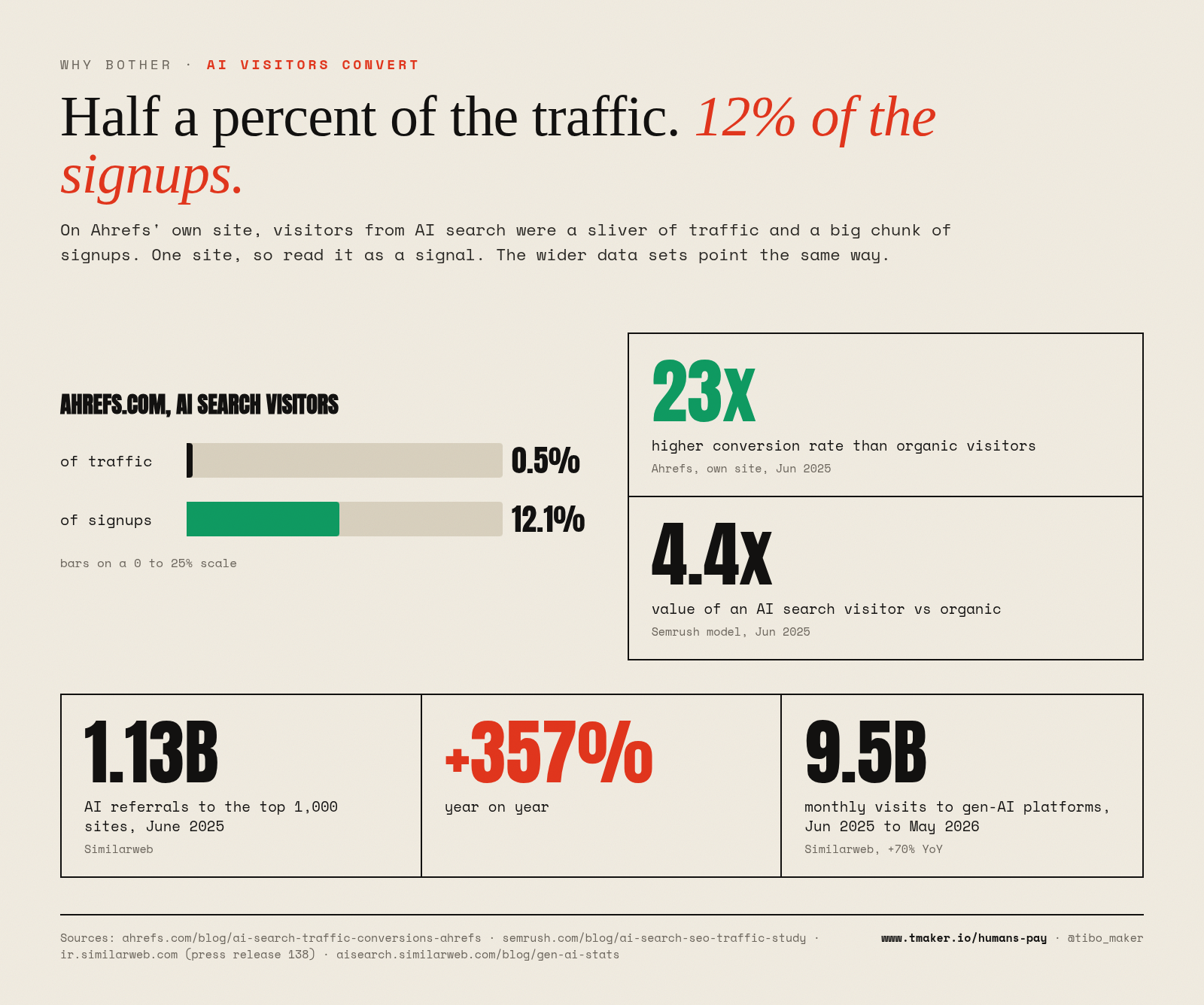
- Infographic: Half a percent of the traffic. 12% of the signups.
- URL: https://www.tmaker.io/humans-pay/infographics/ai-traffic-value.png
- What it shows: on Ahrefs' site, AI search was 0.5% of traffic but 12.1% of signups (about 23x the conversion rate of organic, one site). Semrush models an AI visitor at 4.4x an organic visitor. AI platforms sent 1.13B referrals to the top 1,000 sites in June 2025, up 357% year on year; gen-AI platforms averaged 9.5B monthly visits from June 2025 to May 2026 (Similarweb).
Part 1. How an AI assistant decides which products to name
The mechanics
Assistants that answer "what's the best X" mostly do three things:
- Search. OpenAI describes ChatGPT search as rewriting your prompt into one or more targeted queries for search providers, sometimes followed by more specific ones. OpenAI Help Center Google's AI Mode does the same "query fan-out", splitting a question into subtopics and issuing many searches at once. Google, May 2025 Perplexity, Copilot and Gemini search too. AI Overviews and AI Mode sit on Google's own index.
- Read what those searches return. Because the queries are rewritten sub-questions, the cited pages are often not the top 10 for your exact words: Ahrefs found only 12% of URLs cited by ChatGPT, Gemini and Copilot rank in Google's top 10 for the original prompt. Ahrefs, Aug 11, 2025 Seer Interactive found 87% of SearchGPT citations matched Bing's top 20 organic results, vs 56% for Google (small sample, about 100 questions). Seer, Feb 6, 2025
- Name what keeps coming up. A product that appears across several independent sources is a safe recommendation. A product that only praises itself on its own site isn't.
Outrank's page on this says it simply: "AI recommends the brands it keeps finding online." And: "AI trusts what you say about yourself only when other sites say it too. Your blog gives it the answer, other blogs give it the reason to pick you." Source
Google says the same about its own AI features: "The best practices for SEO remain relevant for AI features in Google Search (such as AI Overviews and AI Mode)", and "There are no additional requirements to appear in AI Overviews or AI Mode, nor other special optimizations necessary." Google Search Central, AI features and your website
My take since February: "the sites getting cited in AI responses didn't optimize for ChatGPT - they are just optimized well." Source
Two words that get mixed up. A citation is a link to your page in an AI answer. A mention is your brand named in the answer. They're related but measured differently. Outrank's study below counts citations. Ahrefs' 75,000-brand study counts mentions. You want both.
What Outrank's 200-site study found
We looked at 200 websites drawn at random from Outrank customers with Search Console connected and at least 500 impressions in the last 28 days (40 from each fifth of the traffic distribution; hosted subdomains excluded). So it's a sample of Outrank customers that already had some Google visibility, not of the whole web, and the backlinks counted are mostly links placed through Outrank's own exchange. For each site, we matched its AI citations, measured by Ahrefs across ChatGPT, Perplexity, Gemini, Copilot, Grok, Google AI Overviews and AI Mode (53,068 citations, September 2026), with its Search Console data, Domain Rating and verified backlinks. Full study
The pattern is a chain, where each step predicts the next (rank correlations across 200 sites, not a controlled test):
- Backlinks and authority. Sites with 150+ verified backlinks had a median DR of 30; sites with fewer than 10 sat at 6 (0.55).
- Authority and Google visibility. Sites at DR 30+ got 18× the Google impressions of sites under DR 10 (0.46).
- Google visibility and citations. Google impressions over 28 days were the strongest single predictor of AI citations (0.80), ahead of clicks (0.75) and pages earning clicks (0.72). Once two sites are equally visible in Google, Domain Rating adds little on its own (partial correlation 0.12): authority seems to work by earning the visibility.
- The gap: sites at DR 30+ got 29× the AI citations of sites under DR 10 (median 100 vs 3.5). Sites with 150+ verified backlinks got 16× the citations of sites with fewer than 10.
- Volume: at the same Google visibility, sites with 100+ articles had up to 3.4× the citations of sites with fewer. Sites with 250+ articles had a median of 301.
- A floor: 67% of sites with fewer than 50 pages showing in Google had zero AI citations. None of the 110 sites with 400+ pages showing in Google had zero.
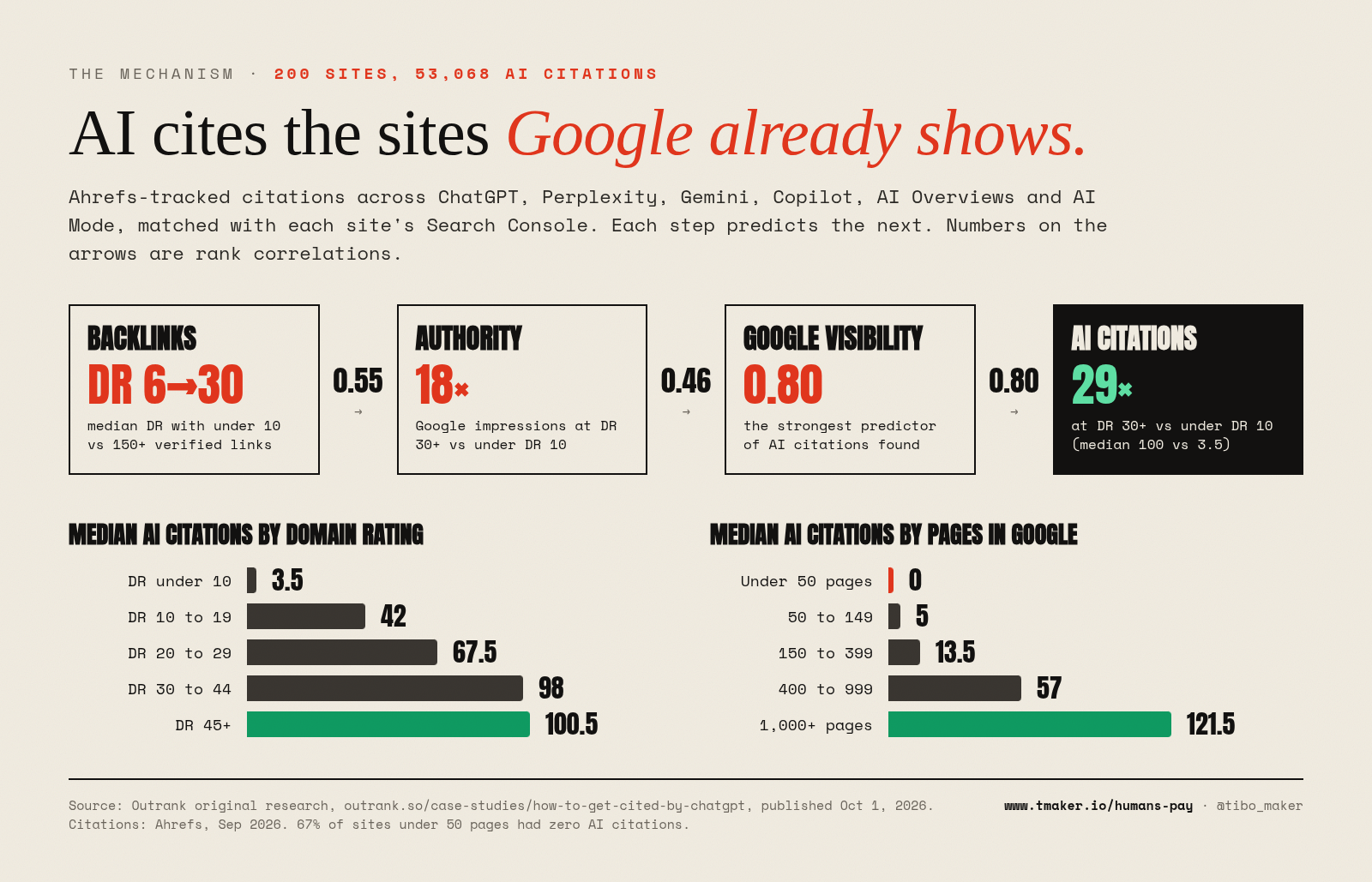
- Infographic: AI cites the sites Google already shows
- URL: https://www.tmaker.io/humans-pay/infographics/ai-citation-chain.png
- What it shows: Outrank's 200-site study: backlinks (median DR 6 vs 30) to authority (18× Google impressions at DR 30+) to Google visibility (0.80 correlation with AI citations) to AI citations (29× at DR 30+ vs under DR 10, median 100 vs 3.5). Bar charts: median AI citations by DR band (3.5, 42, 67.5, 98, 100.5) and by pages visible in Google (0, 5, 13.5, 57, 121.5).
Which assistant cites most. Perplexity gave out 41.6% of the recorded citations, Copilot 19%, AI Mode 13%, Gemini 12%, AI Overviews 10% and ChatGPT 4.8%. That doesn't make ChatGPT irrelevant: it cites less per answer, but it still quoted 114 of the 200 sites, and it has the biggest audience. Grok returned no citations for any site in the sample. If you want to see your first AI citation, look at Perplexity and Copilot.
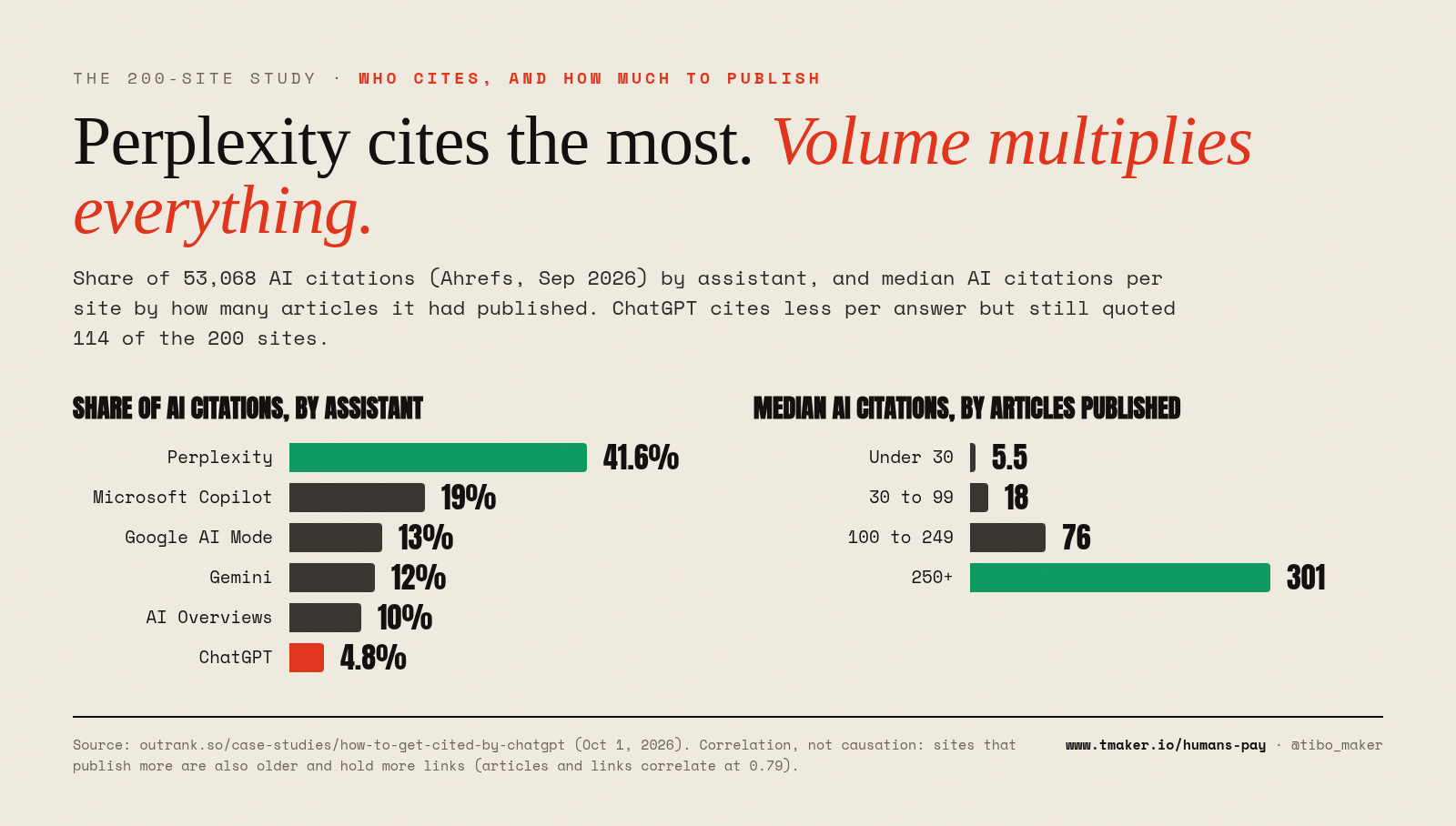
- Infographic: Perplexity cites the most. Volume multiplies everything.
- URL: https://www.tmaker.io/humans-pay/infographics/ai-citations-by-assistant-and-volume.png
- What it shows: share of 53,068 AI citations by assistant: Perplexity 41.6%, Copilot 19%, AI Mode 13%, Gemini 12%, AI Overviews 10%, ChatGPT 4.8% (ChatGPT still cited 114 of 200 sites). Median AI citations per site by articles published: under 30: 5.5; 30 to 99: 18; 100 to 249: 76; 250+: 301. Correlation, not causation: articles and links correlate at 0.79.
The study lists its own reasons to discount it: established sites have more of everything; in the Outrank exchange, sites that publish more also receive more links (correlation 0.79), so the two effects are hard to separate; Ahrefs tracks a fixed set of prompts; and it's a single snapshot, so it can't say how fast citations follow authority.
Does independent research back the chain?
Mostly, with one real disagreement:
- Google visibility and AI. Seer Interactive ran 10,000 questions through GPT-4o: "Brands ranking on page 1 of Google showed a strong correlation (~0.65) with LLM mentions" (Bing: ~0.5 to 0.6). Seer, Jan 7, 2025 Ahrefs found 76.1% of AI Overview citations ranked in Google's top 10 in July 2025, then 37.9% in a March 2026 re-run with improved parsing (not directly comparable). Ahrefs, Jul 2025, Ahrefs, Mar 2, 2026 Semrush found Google AI Mode shares about 54% of domains with Google's top 10, and Perplexity over 91%. Semrush, Jul 21, 2025
- Mentions over raw links. Ahrefs' 75,000-brand study of AI Overviews: branded web mentions correlated 0.664 with AI visibility, Domain Rating 0.326, number of backlinks 0.218. Ahrefs, May 26, 2025 Same direction as Outrank's finding that links matter through the visibility and mentions they earn.
- Fresh pages. Ahrefs (about 17M cited URLs): pages cited by AI assistants were on average 25.7% fresher than pages in organic results. Ahrefs, Jul 28, 2025
- The disagreement: volume. Outrank found more articles went with more citations at equal visibility; Ahrefs found almost no relationship between page count and AI visibility (Part 6).
What independent research says
Mentions beat raw link counts. Ahrefs studied 75,000 brands across ChatGPT, AI Mode and AI Overviews. YouTube mentions had the strongest correlation across all three surfaces (about 0.737, almost identical for ChatGPT). For ChatGPT specifically: branded web mentions 0.664, branded anchors 0.511, branded search volume 0.352, Domain Rating 0.266, branded traffic 0.235. Raw backlink counts were described as very weak. Ahrefs also found almost no relationship between a site's page count and AI visibility, and that ChatGPT is less gated by traditional authority metrics than Google's AI surfaces. Ahrefs, Dec 12, 2025 Part 6 deals with where that disagrees with Outrank's numbers.
What I take from it: a link inside a real article on a site with readers is also a brand mention, and that's the part that matters. A link in a footer on a site nobody reads is neither.
"Best X" lists are the biggest source type for product questions. Ahrefs looked at 26,283 source URLs ChatGPT cited for 750 top-of-funnel prompts: "best X" blog lists were 43.8% of cited page types. 79.1% of those lists had been updated in 2025. In 67.6% of Google "best X software" results, there was a list where the author's own company ranked itself first. Ahrefs, Dec 4, 2025
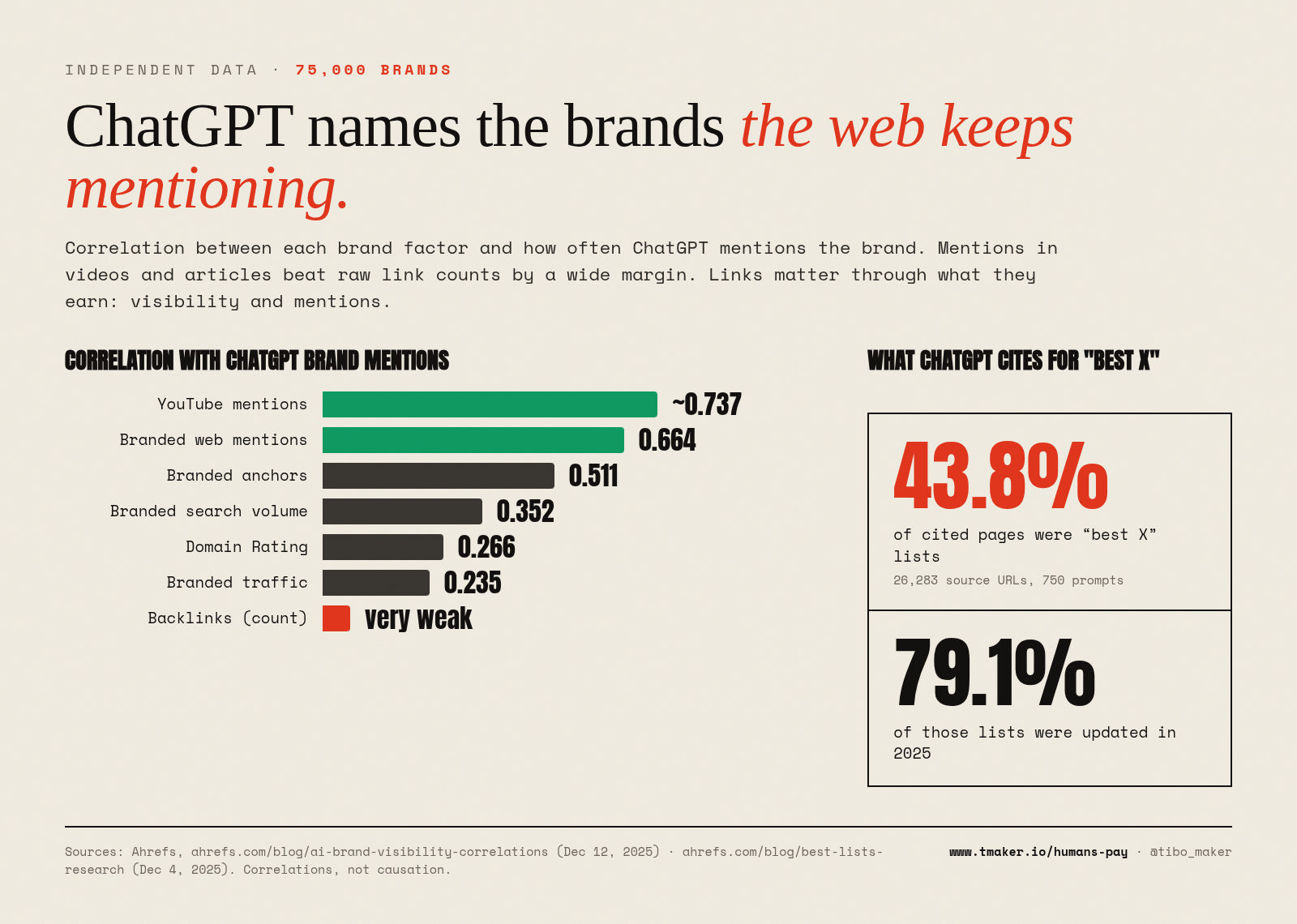
- Infographic: ChatGPT names the brands the web keeps mentioning
- URL: https://www.tmaker.io/humans-pay/infographics/chatgpt-brand-factors.png
- What it shows: Ahrefs' correlations (75k brands): YouTube mentions ~0.737 (across ChatGPT, AI Mode and AI Overviews), and for ChatGPT: branded web mentions 0.664, branded anchors 0.511, branded search volume 0.352, Domain Rating 0.266, branded traffic 0.235, raw backlinks very weak. Plus: 43.8% of pages ChatGPT cited for 750 prompts were 'best X' lists, and 79.1% of those were updated in 2025.
Which domains get cited depends on the assistant. Profound analyzed 680M citations (August 2024 to June 2025): Wikipedia was ChatGPT's top cited domain (7.8% of its citations); Reddit was the top domain for Perplexity (6.6%) and Google AI Overviews (2.2%). Profound
Answers are unstable. SparkToro and Gumshoe had 600 volunteers run 12 prompts 2,961 times in ChatGPT, Claude and Google AI: the odds of getting the same brand list twice were under 1 in 100. As reported by Search Engine Land. Being named is a probability. The levers raise it.
Page details help, a little. The Princeton GEO paper (KDD 2024) found that adding quotations, statistics and cited sources made a source more visible inside generated answers, while keyword stuffing hurt. Gains were largest for sources that started lower, and top-ranked sources lost visibility with the same edits. Aggarwal et al., arXiv 2311.09735 It only helps pages that get retrieved in the first place.
Part 2. Measure before you touch anything
You can't improve a share of AI answers you've never looked at. This is the method I use, and what we built Outrank's AI Overview tracker around. Source
- Write the prompts your buyers actually type. 20 to 30 category questions, not your brand name. "Best AI job application tool", "Tally alternatives", "how do I get customers from Reddit", "best SEO tool for a Shopify store".
- Run them where your users are. ChatGPT, Perplexity, Gemini, Copilot, Google AI Overviews and AI Mode, in the countries your customers live in.
- Run each prompt 5 to 10 times. Lists rarely repeat (SparkToro: under 1 in 100), so a single run tells you little. Record how often you're named: "named in 3 of 10 runs" is a real metric; "yes/no" isn't.
- Log which pages get cited. Those are the listicles, threads and articles you need to be on.
- Compare your pages with the cited ones. The gap is usually one of three things: no page answering that question, not on the cited listicles, or nobody on Reddit has ever mentioned you.
- Track the leading indicator. Your share of answers is the outcome. Google impressions were the best predictor of AI citations in Outrank's study, so watch them weekly.
- Track what it brings. In analytics, segment referrals from chatgpt.com, perplexity.ai, gemini.google.com and copilot.microsoft.com, and add "how did you hear about us?" to signup. Many AI-influenced visitors arrive by typing your name.
- Re-run monthly. Tools like Ahrefs Brand Radar, Profound, Semrush or Outrank's tracker automate this; a spreadsheet works to start.
Make sure assistants can read you at all. Check robots.txt doesn't block the search crawlers assistants use (OAI-SearchBot and ChatGPT-User for ChatGPT, PerplexityBot, Bingbot, Googlebot). Given the Bing overlap Seer found, verify your site in Bing Webmaster Tools and submit your sitemap there too (IndexNow helps new pages get picked up). Serve your main content as HTML: Vercel found none of the major AI crawlers it measured rendered JavaScript. Vercel, Dec 17, 2024
Part 3. The 5 levers, in depth
Lever 1. Make your product super niche
An AI answer names a handful of products per question. If you're "a marketing tool", you're competing with every marketing tool for a few slots. If you're "the AI job-application tool", there's a shorter list and you can be on it.
- One sentence, everywhere. "The X for Y." Homepage title, meta description, About page, social bios, the first line of every guest post. Assistants learn what you are from repetition across sources.
- Own the category page. Write the definitive page for the narrow category ("what is an AI job application tool, and how to choose one").
- Comparison and alternatives pages. "You vs competitor" and "competitor alternatives" are exactly what buyers ask AI. If you don't write them, someone else's list answers for you.
- Pages that do, not only pages that explain. Outrank sorted 6.2M pages from 3,332 sites by format and compared each with the same site's articles at the same Google positions (4 to 10). Free tools and calculators got 2.11× the click-through rate; "best X" listicles 0.69×; "what is" definitions 0.52×. Free tools got 14.2% of impressions but 34.1% of clicks; blog articles 35% of impressions but 9.6% of clicks. Outrank, content formats study An AI can summarize your definition. It can't run your calculator. (Being on other people's listicles still matters for AI mentions; this is about what you publish yourself.)
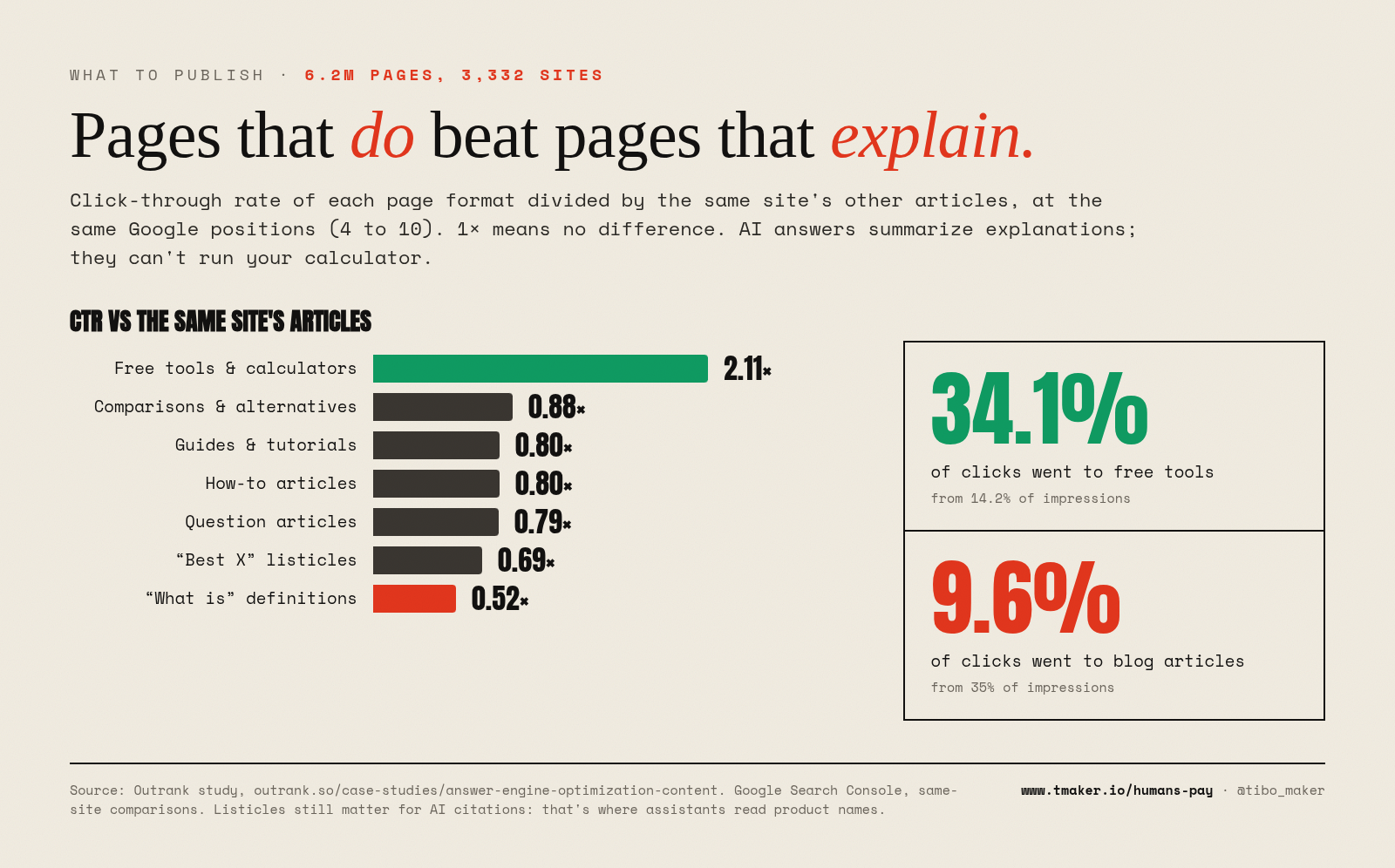
- Infographic: Pages that do beat pages that explain
- URL: https://www.tmaker.io/humans-pay/infographics/content-formats-ctr.png
- What it shows: Google click-through rate by page format, relative to the same site's articles at positions 4 to 10 (6.2M pages, 3,332 sites): free tools and calculators 2.11×, comparisons and alternatives 0.88×, guides and tutorials 0.80×, how-to articles 0.80×, question articles 0.79×, 'best X' listicles 0.69×, 'what is' definitions 0.52×. Free tools got 34.1% of clicks from 14.2% of impressions; blog articles got 9.6% of clicks from 35% of impressions.
Example: AIApply, an AI job-application product in the crowded job-search space, and an Outrank customer since March 2024. Content used to happen "when we can". With 331 articles published and 287 verified backlinks, Google clicks for May to July 2026 were 270,592, up 44% on the same months of 2025, and Ahrefs counts 1,368 AI citations across 271 pages. Case study In CEO Aidan Cramer's words: "The biggest visible shift: our brand started getting picked up in AI answers." And: "Over time, it compounds: more pages indexed, more references, stronger domain signals, and more chances to be the source AI systems pull from." Source
Lever 2. Be the best in your category
No trick here, and I wish there were one.
The best example I've seen is Tally. They made their form builder (almost) 100% free. I think it's very smart, because it makes them the obvious choice for ChatGPT to recommend. Serious big buyers will still buy, occasional buyers won't, and those were churning anyway. (Not affiliated.) Source
In my experience, "best" to an assistant looks like:
- Something the user can try right now: a generous free tier or trial.
- Lots of people saying it's good, in public: reviews on G2, Capterra or Trustpilot, Reddit comments, tweets, case studies. Assistants repeat consensus.
- Specific, checkable claims. "Median 2.1 days from order to published" travels further than "fast".
- Honest limits. On Outrank's pricing I say that if SEO is already your #1 channel with $10-20k a month to spend, Outrank may not be the best fit. Source
Lever 3. Get into listicles
I asked AI how to get ChatGPT to mention my product more.
AI: get #1 into listicles. me: but how? AI: reach out to blog owners, ask them, pay them.
So I did. Results: 400+ owners reached, 3 replies, crazy rates, 1 listicle live. Those lists are saturated, and there is no easy way in. Source
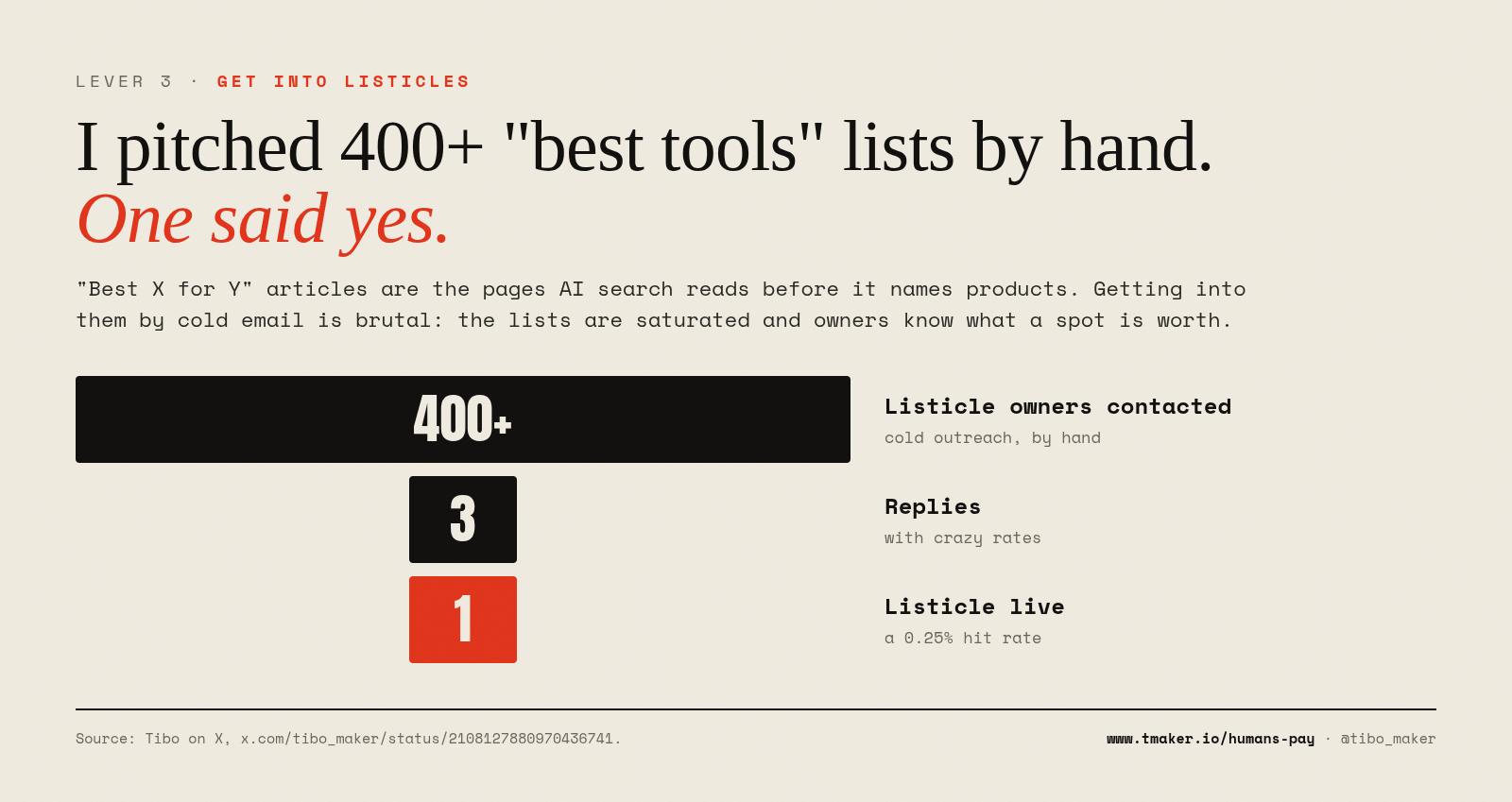
- Infographic: I pitched 400+ listicles by hand. One said yes
- URL: https://www.tmaker.io/humans-pay/infographics/listicle-outreach-funnel.png
- What it shows: a funnel from 400+ listicle owners contacted by cold outreach, to 3 replies (with very high rates), to 1 listicle live: roughly a 0.25% hit rate.
Why they matter. Assistants run rewritten searches around "best X". Those results are dominated by "best X" articles (43.8% of cited page types in Ahrefs' study). A separate study of 1,056,727 citations across ChatGPT, Google AI Mode and Perplexity found listicles were the most cited content type (21.9%), and "40% of commercial queries cite listicles, nearly double other intents." Wix Studio AI Search Lab, Mar 23, 2026 So being on several of them matters more than anything on your own site.
By hand:
- Run your prompt set (Part 2) and collect every listicle the assistants cite.
- Prioritize the ones that also rank on Google and Bing for "best [category]".
- Offer the owner something real: a free account to review, a reader discount, original data they can cite.
- Expect most to ask for money and many to never answer. If you pay, ask for the placement to be disclosed to readers.
How I do it now. Outrank's Scale Backlinks plan ($899/month) includes "first place in listicle articles, with a screenshot and a description" on vetted blogs, with "your link is the only paid one in the article". Source To be clear about how it works: Outrank generates the article around your placement and publishes it on the host blog, and your #1 spot is paid. That's what makes it fast. It's also why it isn't a substitute for earning a genuine review somewhere.
Lever 4. Get links and mentions from sites people actually read
A few weeks ago many people on X called Outrank a link farm. Some of it was fair: to get backlinks from our exchange, you had to host other people's links on your own site, and SEOs don't trust that kind of loop. Source
So we spent 8 weeks building a marketplace that works differently. On the marketplace, you don't host anyone's links. Outrank generates a full article with your link in it and publishes it on a vetted site's own blog, and we pay that site in cash through Stripe. The hardest part was deciding who gets to sell: 1,625 sites signed up and only 138 made it in. A site needs DR 30+, 100+ clicks a month for at least 3 months, and Search Console connected so we can see its real Google traffic. Then it has to pass a content check, which 220 sites failed on their own. Since August: 222 placements, 159 live, 158 of those dofollow, median 2.1 days from order to published.
I care about "real" because ChatGPT and Perplexity cite the sites people actually read. Nobody reads a private blog network, so nobody cites one. My bet is that AI search ends up rewarding fewer links from sites with real readers.
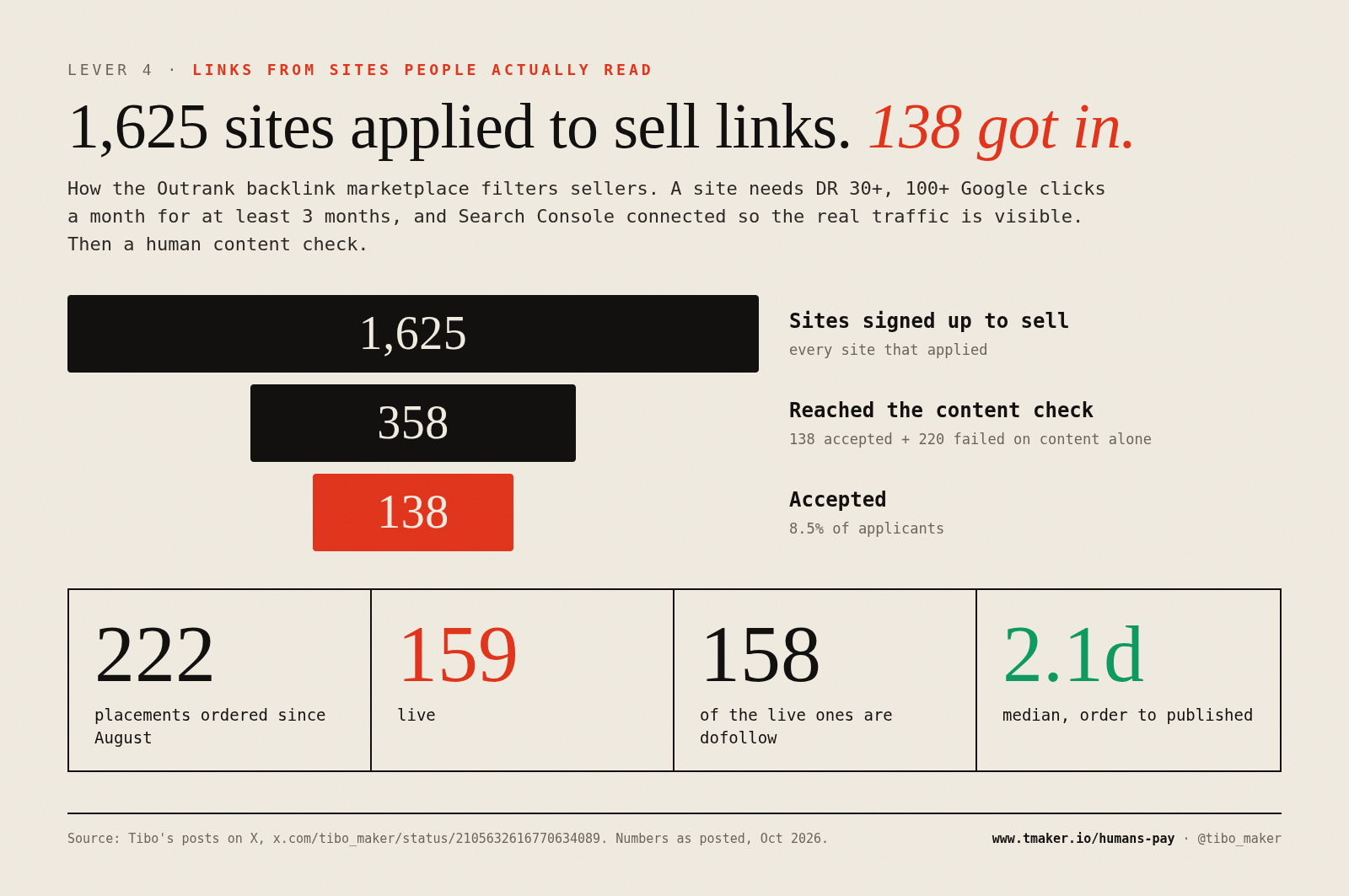
- Infographic: 1,625 sites applied to sell links. 138 got in
- URL: https://www.tmaker.io/humans-pay/infographics/outrank-marketplace-vetting.png
- What it shows: how the Outrank backlink marketplace filters sellers: 1,625 applicants, 358 reached the content check, 138 accepted (8.5%). Requirements: DR 30+, 100+ Google clicks a month for 3+ months, Search Console connected, then a content check that 220 sites failed. Since August: 222 placements ordered, 159 live, 158 of those dofollow, median 2.1 days from order to published.
Know the trade-off. These are paid placements, and Outrank inserts them as normal editorial dofollow links ("we never add a nofollow attribute"). Source Google's spam policies list "Buying or selling links for ranking purposes" as link spam, and accept paid links when they're "qualified with a rel="nofollow" or rel="sponsored" attribute value". Google spam policies The bet is that placements on vetted sites with real traffic, inside relevant articles, behave like the earned links they resemble. If your brand can't accept any of that risk, use the content side and earned mentions only.
Does it move anything? Two Outrank data sets, both correlational, both measuring Google traffic. Neither measures AI citations directly; the link to AI rests on the independent finding that Google visibility goes with AI mentions (Part 1).
- After SEO Twitter decided Outrank "burns domains", I grouped users' Search Console data by how many of our backlinks they'd received. Users with 0 to 9 links: +24% Google clicks since joining. Users with 400+: +115%. Source Heavy users also publish more and have been customers longer, so this isn't proof that links alone did it.
- In Outrank's Search Console study, 1,383 sites with data before and after joining went from a median 297 to 814 clicks per 28 days (2.7×). 75.4% gained clicks and 50.7% at least doubled; 24.4% had fewer, and 8.2% lost half or more. On the wider 2,119-site curve, the median site was +7% in the first 28 days, +27% by days 57 to 84, and 2.0× its baseline around month 7. The study's own caveats: sites were already growing before joining (that trend alone would reach about 1.5× by month 7), there's no control group, and sites that left early drop out of later months. Source
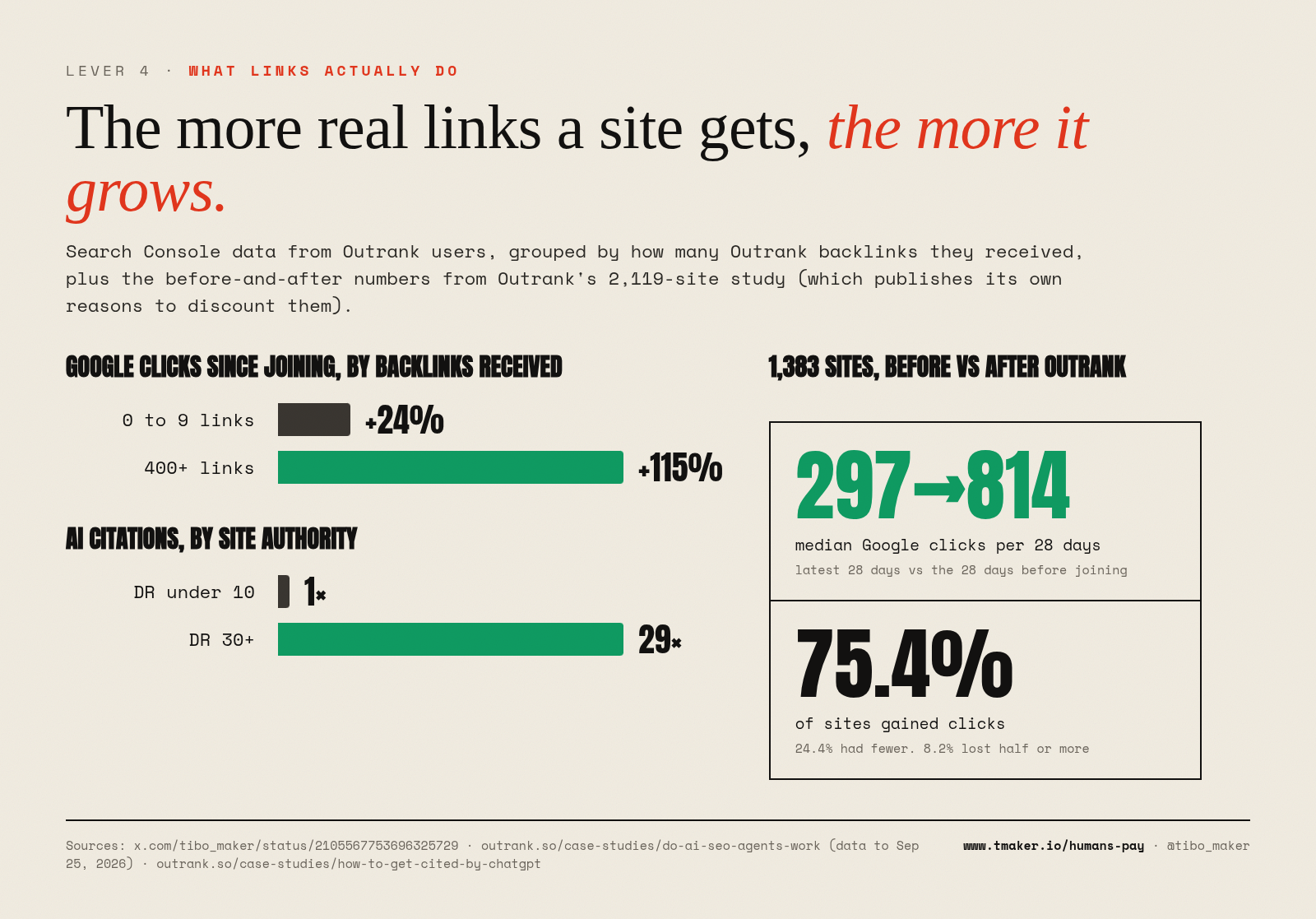
- Infographic: The more real links a site gets, the more it grows
- URL: https://www.tmaker.io/humans-pay/infographics/links-vs-growth.png
- What it shows: Google clicks since joining Outrank: +24% for users with 0 to 9 backlinks vs +115% for users with 400+ (correlation). AI citations: 29× at DR 30+ vs under DR 10 (200-site study). Before vs after for 1,383 sites: median clicks per 28 days 297 to 814; 75.4% gained clicks, 24.4% had fewer, 8.2% lost half or more.
What customers say, in their own words (self-reported quotes; the Scalelist and 24hourEDU numbers come from Outrank case studies using Ahrefs and Search Console):
- Arnaud Renoux, Scalelist (B2B lead data, a crowded category): manual link building had stalled at DR 15. Ahrefs shows DR 16 in September 2025 and 45 in August 2026, with 327 verified backlinks and 206 articles. "I got a massive DR increase in the first 3-4 weeks of working together." Case study
- Jesse Kennedy, 24hourEDU: a new domain went from DR 1.2 to 30, and monthly clicks from 754 to 1,735 (July to July). "We have spent thousands more on SEO experts, who have not increased organic traffic like this ever." Case study
- Semir Jahic, bootstrapped SaaS, team of 2: "we grew traffic 5x and domain authority from <10 to 30 in 5 6 months" [sic]. Source
- Virgile Rietsch: "Been using @outrank_so for a month. Results : DR 6 -> 19 Clicks : 150 > 350+" Source
- Ezra (ThePresellsGuy): "I built my own in-house process for writing content, but it still took quite a bit of management on my end and it didn't help us build backlinks. Now we're at 12DR and hit 300 clicks in the last 28 days." Source
- A fair, mixed one, Luc: "Outrank is useful for increasing SEO output, but I still want my agents/human review sitting between the tool and production." Source That's a healthy way to use any content tool.
Lever 5. Get on Reddit
Many people called Reddit dead because ChatGPT stopped citing it. I think that's wrong. Source
Promptwatch reported Reddit's share of ChatGPT search citations falling from 3.83% (July 18 to August 7, 2026) to 0.52% (August 14 to 17), and calls the size of the drop provisional. Semrush on Promptwatch's data Meanwhile Ahrefs looked at 145M US Google results: when the "discussions and forums" block shows up, Reddit is in it about 84% of the time. And the baselines don't agree: Ahrefs had Reddit at 16.7% of ChatGPT citations around the same time, and Semrush measured something else entirely, the share of ChatGPT responses citing Reddit, which it saw fall from close to 60% in early August 2025 to around 10% by mid-September 2025. Semrush Three trackers, three different numbers.
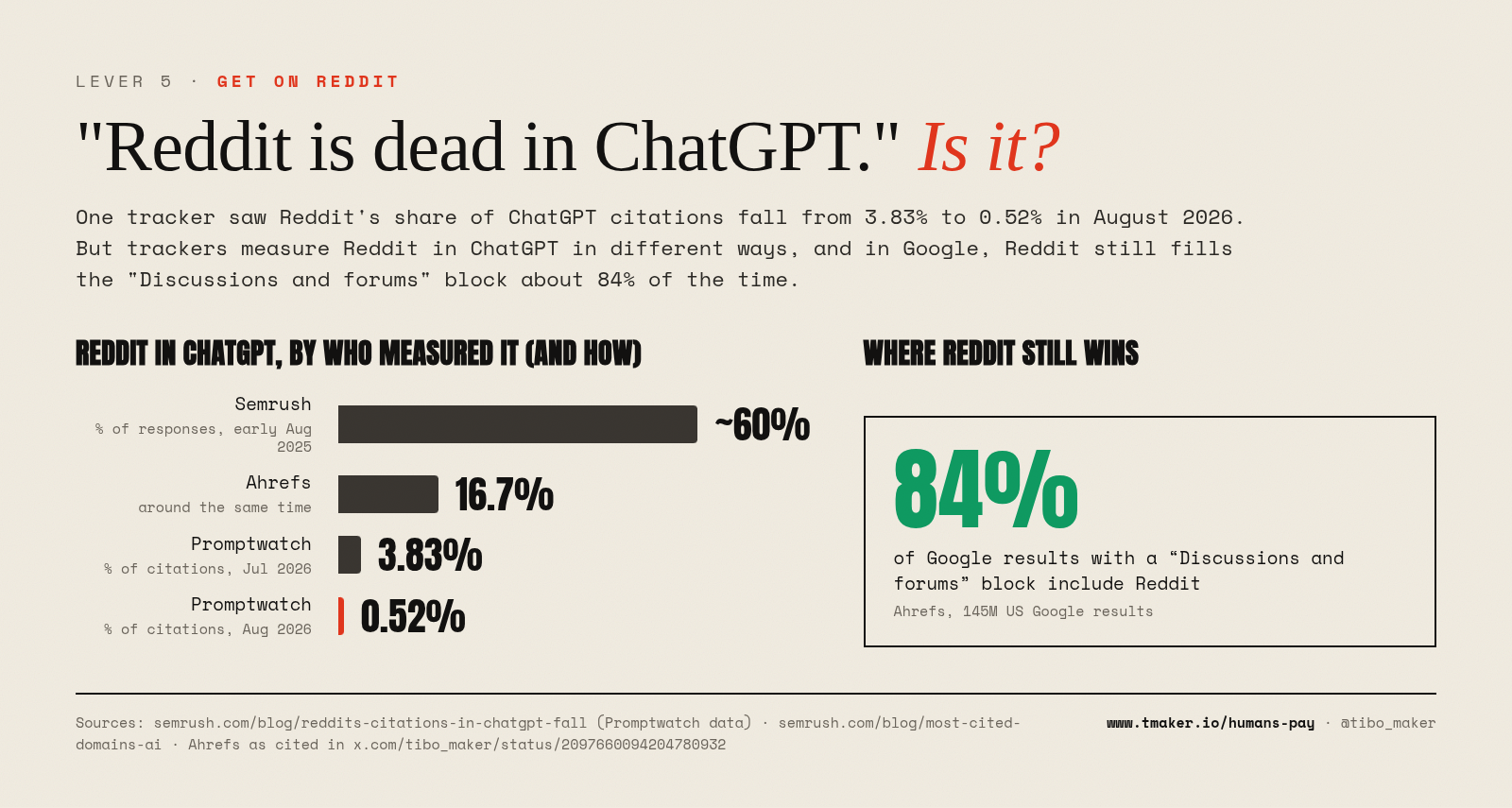
- Infographic: Reddit is dead in ChatGPT. Is it?
- URL: https://www.tmaker.io/humans-pay/infographics/reddit-citation-paradox.png
- What it shows: Reddit in ChatGPT depends on who measured it and how: Semrush, share of ChatGPT responses citing Reddit, close to 60% in early August 2025 (a different metric); Ahrefs 16.7% of citations; Promptwatch 3.83% of citations in July 2026 and 0.52% in August 2026. Meanwhile, Reddit appears in about 84% of Google 'Discussions and forums' blocks (Ahrefs, 145M US results).
Why I keep investing in Reddit:
- Reddit threads rank on Google, and Google visibility is what assistants draw from. SISTRIX: "The domain reddit.com is the 4th most visible domain in Google Search, US" (July 2026 data), though growth has slowed since a peak in October 2025. SISTRIX
- Assistants still cite it. Even after the drop, Semrush wrote that "Reddit and Wikipedia are still ChatGPT's two most-cited domains", and Reddit topped Perplexity's sources. Semrush, Nov 10, 2025 Profound's data has Reddit at 46.7% of Perplexity's top-10 sources. Profound
- Assistants look for real opinions. A product recommended by users in a thread is a stronger signal than a product recommending itself.
- It brings customers directly, which no citation tracker measures.
Reddit is miserable to market on. It takes months of being useful before anyone lets you mention what you built. So do the slow, useful part anyway: "warm up your account with karma. contribute genuinely. don't look at quantity, look at quality. one thoughtful thread beats ten promotional drops." Source
How Bazzly fits, plainly. Bazzly scans Reddit 24/7 for threads where your product fits, drafts replies, and helps you DM the people asking. It can post from your own account (via a Chrome extension) or from Bazzly's warmed-up high-karma accounts, and it sells "smart upvotes to push your reply above the rest". Source Bazzly crossed $10k MRR in September, and on October 6, 2026, ChatGPT named it the best Reddit tool when I asked (one answer on one day; answers vary a lot, see Part 1). Source Know the trade-off: Reddit's rules ask users to "Participate authentically in communities where you have a personal interest, and do not spam or engage in disruptive behaviors (including content manipulation)", and Reddiquette says not to "Create mass downvote or upvote campaigns". Reddit Rules, Reddiquette Reddit also prohibits vote manipulation, and replies posted from accounts that aren't yours don't tell readers who's behind them. The setup I'd defend in public is your own account, a genuinely useful reply, and boosts only on replies you'd stand behind. Someone asked whether paid upvotes produce "real trust or manufactured social proof". Source Fair question: a boost only gets a reply seen, and a useless reply gets buried or reported anyway.
What users say (self-reported; Bazzly doesn't track customers' signups or traffic, so these are their own numbers):
- Victoria Matejevic, co-founder of vtoraraka.mk: "Reddit went from hit-or-miss to around 60 signups a month. And I'm spending WAY less time on it." Source
- Arnaud Belinga: "I tested 20+ Reddit tools. I always got disappointed. Then I tried Bazzly ... Meanwhile I get clients from Reddit every week because of it." Source
- Ezra (ThePresellsGuy): "I know for sure we've converted some customers from this channel. But, also appreciate that it helps GEO/AEO by getting your product name out there on reddit." Source
Beyond the 5: YouTube, Wikipedia, review sites
- YouTube. In Ahrefs' 75k-brand study, YouTube mentions were the single strongest correlate of AI visibility (about 0.737). That's mentions of your brand in videos, including other people's. Make short explainers and comparisons in your category, and get reviewed by creators in your niche. If you don't make videos, generate them (we use Revid) and post anyway.
- Wikipedia and Wikidata. Wikipedia is ChatGPT's top cited domain in Profound's data. You can't write your own page, but if you're notable, make sure the facts about your category and company are accurate and sourced.
- Review and comparison sites. G2, Capterra, Trustpilot and the "X vs Y" pages that rank for your category. Ask happy customers for reviews; these are the "lots of people saying it's good" in Lever 2.
- LinkedIn, Quora and Q&A forums feed AI search the same way Reddit does, on a smaller scale.
Part 4. Proof: what it looks like when it works
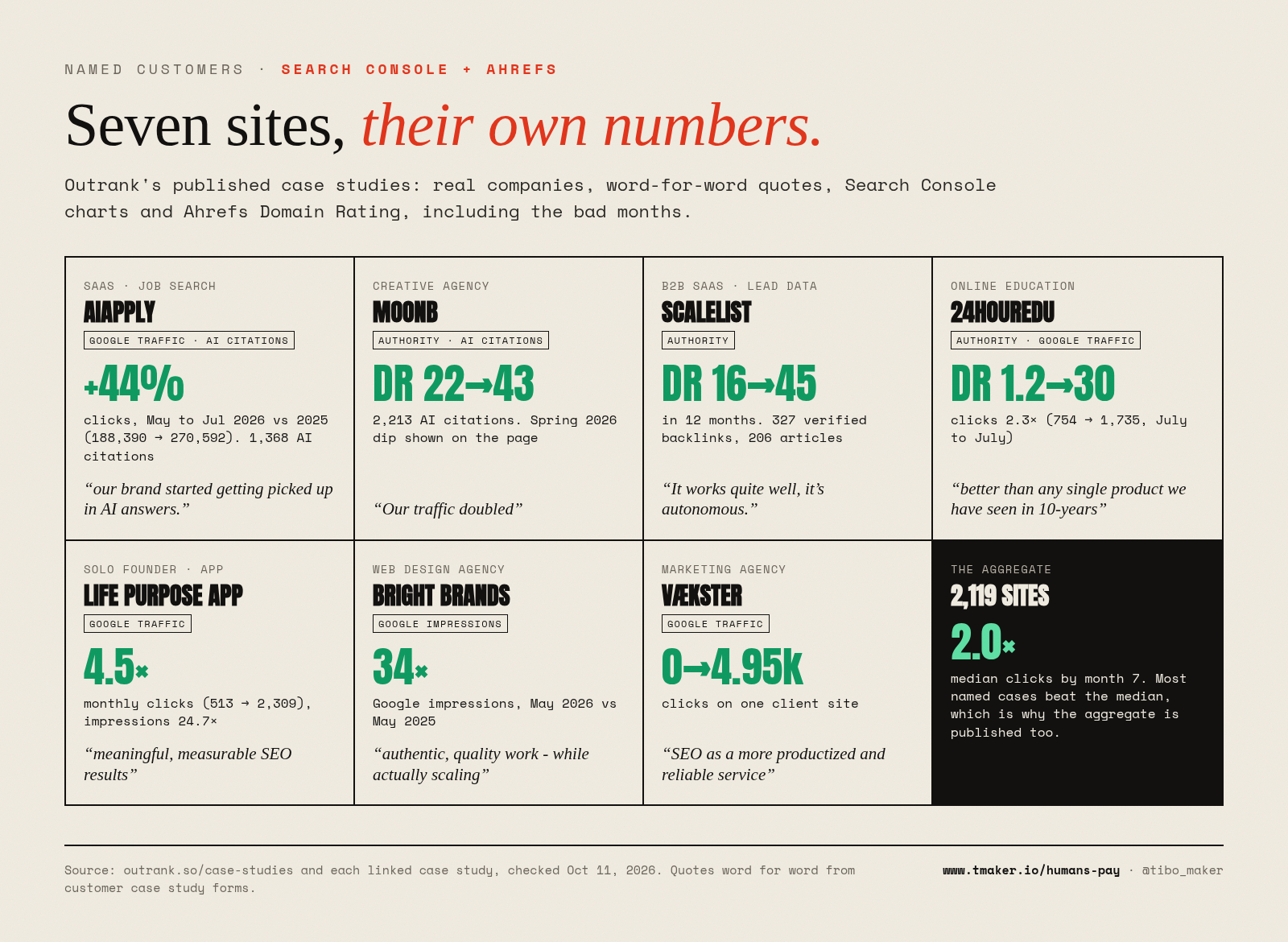
- Infographic: Seven sites, their own numbers
- URL: https://www.tmaker.io/humans-pay/infographics/outrank-customer-results.png
- What it shows: Outrank's named case studies: AIApply +44% clicks May to July 2026 vs 2025, 1,368 AI citations; Moonb DR 22 to 43, 2,213 AI citations; Scalelist DR 16 to 45 in 12 months; 24hourEDU DR 1.2 to 30 and clicks 2.3×; Life Purpose App 4.5× monthly clicks; Bright Brands 34× Google impressions; Vækster 0 to 4.95k clicks on one client site. Aggregate: 2,119 sites, median 2.0× clicks by month 7. Most named cases beat the median.
Outrank's published case studies use Search Console data, Ahrefs Domain Rating that Outrank doesn't control, named people with word-for-word quotes, and the bad months. All case studies
Each result below is tagged with the outcome it measures.
- Moonb (creative agency) [Authority, Google traffic, AI citations; Outrank case study]: DR 22 to 43 on Ahrefs; monthly clicks 1,409 (July 2025) to 4,980 (January 2026), with a spring 2026 dip to 741 in April shown on the same page. 2,213 AI citations across 165 pages, led by Perplexity (529), AI Mode and Copilot; ChatGPT cited it 3 times. Lorenzo Nicolini: "Our traffic doubled, people started reaching out to do backlink collaborations too." Case study
- Life Purpose App (solo founder, online since 2013) [Google traffic; Outrank case study]: monthly clicks 513 (May 2025) to 2,309 (May 2026), impressions 24.7×, 450 articles. Martin Adams: "It's the first tool I've used that delivers meaningful, measurable SEO results instead of superficial optimization." Case study
- Bright Brands (web design agency) [Google traffic, impressions only; Outrank case study]: 34× Google impressions, May 2026 vs May 2025. Vækster (digital marketing agency) [Google traffic; Outrank case study]: 0 to 4.95k clicks on one client site. Case studies
- Rip Van, a Shopify snack brand [Google traffic, AI citations; self-reported via my post]: "in 5 years, we only had 20 blog posts". They started publishing in January; blog from zero to 10.5K clicks in 5 months, organic traffic from ~5K a month to 25K+, content in 2.8K AI responses. Source
- Skin Perfection, a Shopify skincare brand stuck around position 23 [Google traffic; AI citations named but not counted; self-reported via my post]: in 6 months, organic clicks from 22,650 to 42,500, impressions up 65%, average position from 23 to ~10, cited in Google AI Overviews, ChatGPT, Grok, Perplexity, Gemini and Copilot. Source
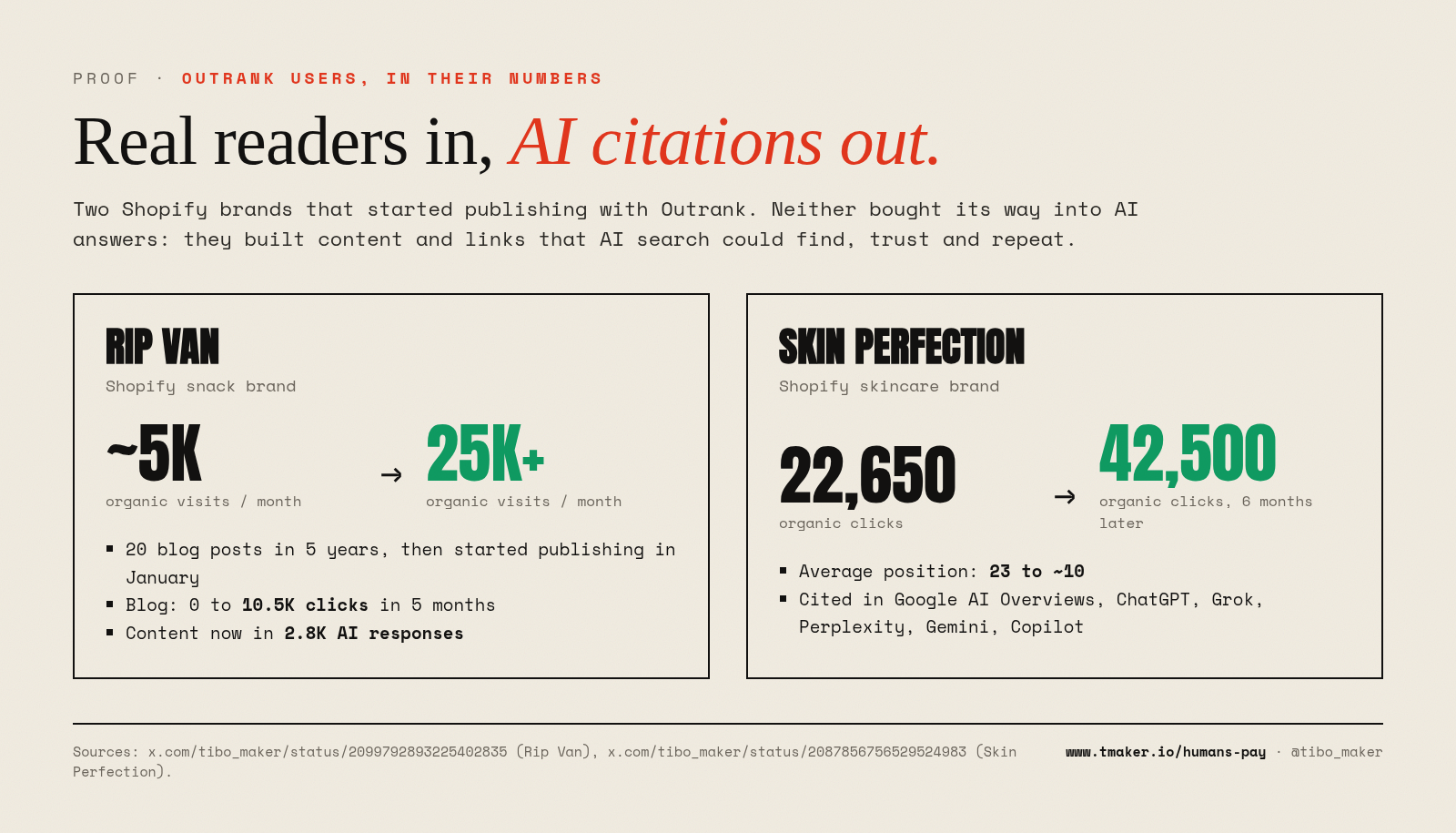
- Infographic: Real readers in, AI citations out
- URL: https://www.tmaker.io/humans-pay/infographics/outrank-case-studies.png
- What it shows: two Shopify brands on Outrank. Rip Van: 20 blog posts in 5 years, then blog from 0 to 10.5K clicks in 5 months, organic traffic from ~5K to 25K+ a month, content in 2.8K AI responses. Skin Perfection: organic clicks from 22,650 to 42,500 in 6 months, average position from 23 to ~10, cited in AI Overviews, ChatGPT, Grok, Perplexity, Gemini and Copilot.
Named case studies are the good stories. The honest aggregate is below: most sites grew, one in four didn't.
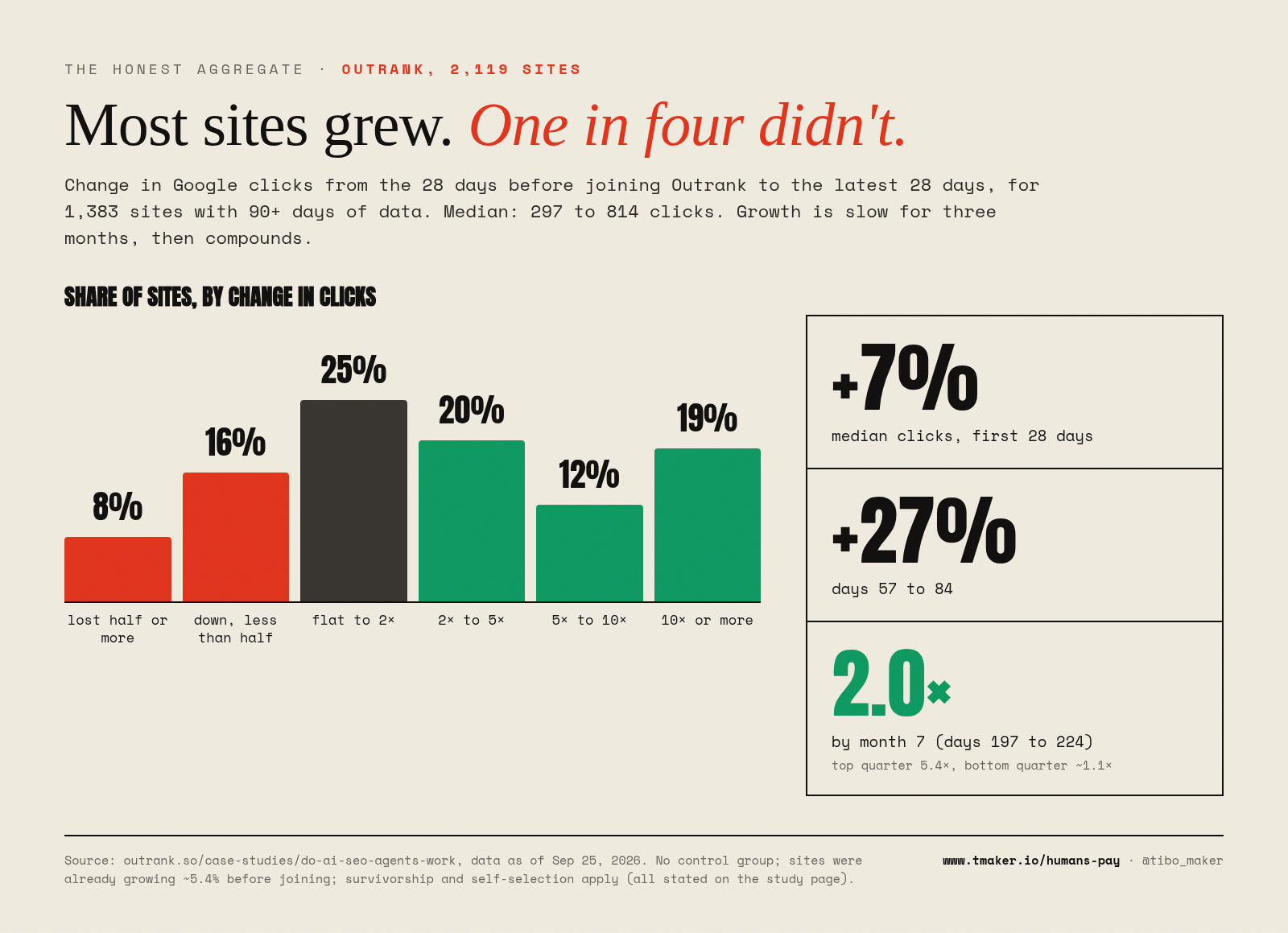
- Infographic: Most sites grew. One in four didn't
- URL: https://www.tmaker.io/humans-pay/infographics/outrank-2119-site-outcomes.png
- What it shows: change in Google clicks for 1,383 Outrank sites, before vs latest 28 days: lost half or more 8%, down less than half 16%, flat to 2× 25%, 2× to 5× 20%, 5× to 10× 12%, 10× or more 19%. On the 2,119-site curve: +7% in the first 28 days, +27% by days 57 to 84, 2.0× by month 7 (top quarter 5.4×, bottom quarter ~1.1×). No control group; sites were already growing before joining.
Across niches with at least 25 sites, 70% to 88% of sites grew; SaaS and tech, the most crowded, sat at the bottom of that range (70%). Sites that auto-published grew more often (76.8%) than those that didn't (62.5%), though the groups started from different traffic levels. Source
As of September 2026, Outrank had generated 1,002,810 articles and verified 473.7k backlinks live; 4,689 sites have Search Console connected. Source
Part 5. The 90-day plan
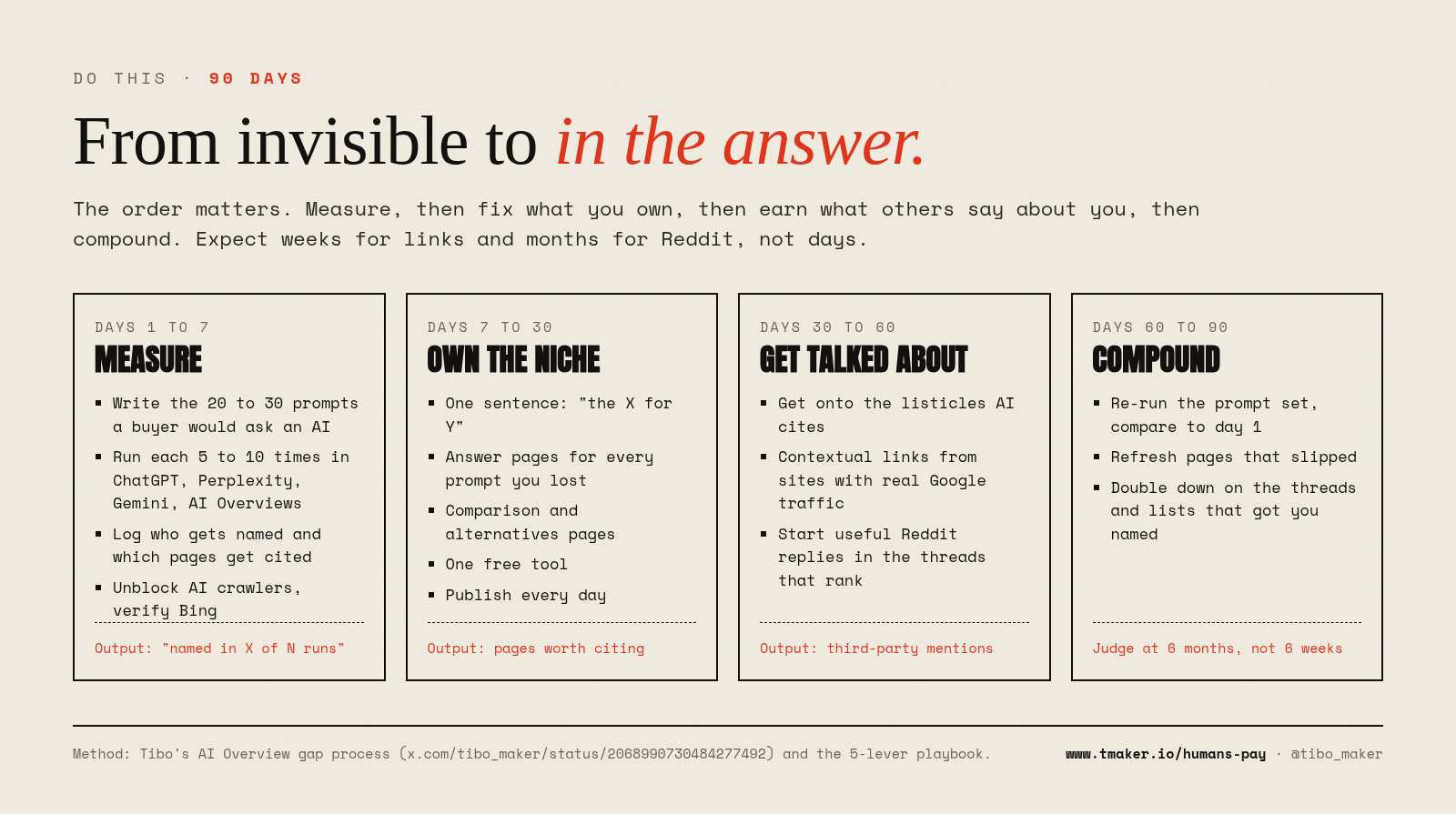
- Infographic: From invisible to in the answer: a 90-day plan
- URL: https://www.tmaker.io/humans-pay/infographics/90-day-plan.png
- What it shows: four phases. Days 1 to 7, measure: 20 to 30 buyer prompts across ChatGPT, Perplexity, Gemini and AI Overviews, run several times, log who's named and which pages are cited. Days 7 to 30, own the niche: one 'X for Y' sentence, answer pages for every lost prompt, comparison and alternatives pages, a free tool, publish daily. Days 30 to 60, get talked about: spots on the cited listicles, contextual links from sites with real traffic, useful Reddit replies in ranking threads. Days 60 to 90, compound: re-run the prompts, refresh slipping pages, double down on what got you named.
Days 1 to 7: measure. Build the prompt set and run it several times per assistant (Part 2). Fix crawler access and Bing verification. Output: a gap list and a baseline ("named in X of N runs" per prompt).
Days 7 to 30: own what you control. Write your one-sentence niche (Lever 1). Publish an answer page for every prompt you lost, plus comparison and alternatives pages, and ship one free tool if your category has an obvious calculator or checker. Publish daily rather than "when we can". Leading indicator: Google impressions climbing.
Days 30 to 60: get talked about. Go after the listicles assistants cited for your prompts (Lever 3). Get contextual links and mentions on sites with real Google traffic (Lever 4). Start replying usefully in Reddit threads that rank for your category (Lever 5). Ask customers for reviews.
Days 60 to 90: compound. Re-run the prompt set and compare with day 1. Refresh pages that slipped (AI assistants cite fresher pages than Google's organic results, by 25.7% on average per Ahrefs). Put more into the specific lists, sites and threads that got you named. A realistic target: first citations in Perplexity and Copilot, and being named in some runs for a handful of prompts. Outrank's data suggests most Google gains arrive after month three, so judge the plan at 6 months, not 6 weeks.
Budget, roughly. Do-it-yourself: your time, plus whatever listicle owners ask. Outrank's base plan: $99/month for 30 articles a month and exchange backlinks. Vetted DR 30+ placements and #1 listicle spots: Outrank Scale Backlinks, $899/month. Reddit with Bazzly: $199/month. Prices checked October 11, 2026.
Part 6. Where the data disagrees (and where I might be wrong)
- Does volume matter? Outrank's study: at the same Google visibility, sites with 100+ articles had up to 3.4× the citations. Ahrefs' 75k-brand study: almost no relationship between page count and AI visibility. My reading: page count alone does nothing, but more pages that each answer a real question give assistants more to retrieve. Both studies are correlational.
- Does authority matter for ChatGPT? Outrank's chain runs through DR and Google visibility. Ahrefs found ChatGPT less gated by traditional authority metrics than Google's AI surfaces, with mentions (especially YouTube) mattering more. My reading: links matter mostly as mentions on pages that get read.
- Google or Bing? Seer found 87% of SearchGPT citations in Bing's top 20 (about 100 questions). Ahrefs found only 12% of cited URLs in Google's top 10 for the original prompt. They measured different things, on different samples, at different times. Cover both engines.
- Is Reddit dead? Depends on the tracker and the metric (Lever 5). Promptwatch calls its own drop provisional.
- Which assistant matters? Perplexity gives out the most citations (41.6% in Outrank's sample); ChatGPT has the biggest audience but cites less per answer, and its share of AI visits is shrinking (Similarweb). Measure all of them.
- Is there a secret AEO playbook? I don't think so: "there's no secret AEO playbook, there's just: does your content actually answer the question better than everyone else?" Source
- Can anyone guarantee a ChatGPT mention? No. Outrank's own FAQ: "No, and you should be wary of anyone who does." Source
- Vendor data. Most numbers on this page come from vendors (including Outrank) studying their own users or tools. Treat any single number, mine included, as a direction.
Part 7. Where Outrank and Bazzly fit, and where they don't
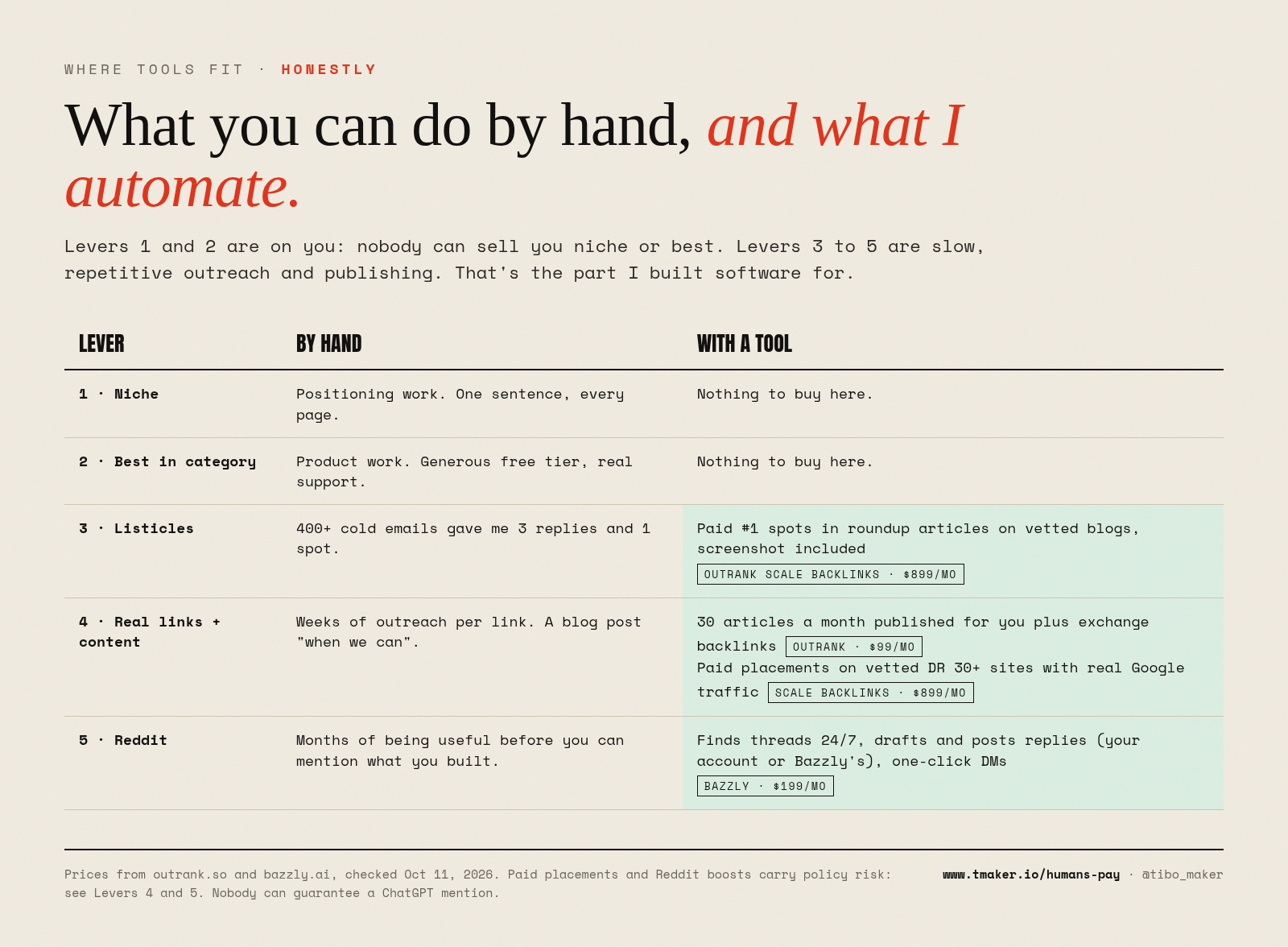
- Infographic: What you can do by hand, and what I automate
- URL: https://www.tmaker.io/humans-pay/infographics/do-it-yourself-vs-tools.png
- What it shows: a table of the 5 levers. Niche and best-in-category: positioning and product work, nothing to buy. Listicles: 400+ cold emails gave 3 replies and 1 spot by hand, vs paid #1 spots on vetted blogs with Outrank Scale Backlinks ($899/mo). Content and links: weeks of outreach per link by hand, vs 30 articles a month plus exchange backlinks on Outrank ($99/mo) and vetted DR 30+ placements on Scale Backlinks. Reddit: months of manual work, vs Bazzly ($199/mo).
Levers 1 and 2 are on you. Nobody can sell you niche or best.
Levers 3 and 4 are what Outrank automates. The $99/month plan does keyword research, writes and publishes 30 articles a month to your CMS, and builds backlinks through the Outrank exchange. Scale Backlinks ($899/month) adds paid placements on vetted DR 30+ blogs with real traffic, including #1 spots on listicles.
Lever 5 is what Bazzly automates, for $199/month.
Why I think they're a good fit for levers 3 to 5:
- They work on the inputs assistants read in every study above: pages search engines show, listicles, sites with real readers, Reddit threads.
- They run every day. Most people stop doing levers 3 to 5 by hand after a few weeks, which is exactly when Outrank's data says gains start to show.
- They're how my own products get cited. On October 6, 2026, ChatGPT named Bazzly the best Reddit tool in one answer. For honesty: Outrank's own site has 1,239 AI citations tracked by Ahrefs, mostly from Perplexity (234), and only 4 from ChatGPT. Source ChatGPT is the hardest one.
When not to use them:
- You already get plenty of press, reviews and organic mentions. Spend on product and PR instead.
- You can't accept paid-link risk (Lever 4) or Reddit's rules on vote manipulation (Lever 5). Use the content side and do Reddit by hand from your own account.
- SEO is already your #1 channel with $10-20k a month to spend. An agency or an in-house team will fit better.
- You need results in weeks. Nothing here is that fast.
Alternatives: digital PR or an agency for listicles and press; doing outreach by hand with the steps in Lever 3; Ahrefs Brand Radar, Profound or Semrush to track AI visibility; Reddit by hand from your own account.
As I put it in August: "2016: build it and they will come. 2021: write content and they will come. 2026: be the answer ChatGPT gives, and they'll come." Source
Bonus: AI might start paying publishers
Google is piloting payments to websites whose content shows up in Gemini, AI Overviews and AI Mode, with monthly earnings shown in Search Console. Source Google confirmed it as an early-stage "AI contribution" pilot where pay depends on whether a site's content contributes meaningfully to an answer, not on clicks. Search Engine Land, 9to5Google, Sep 17, 2026 It's a test and payouts reportedly vary a lot, but if it scales, being the source an AI uses could pay directly, not only through clicks.
FAQ
How long until an AI assistant names my product? There's no good time-to-citation data yet; Outrank's study is a snapshot. Google visibility comes first, and in Outrank's data Google clicks were +7% in the first 28 days, +27% by days 57 to 84, and about 2.0× by month 7. Source Plan in months. Reddit takes months of being useful.
Which assistant should I care about most? The one your buyers use. Perplexity cites the most and shows results first; ChatGPT has the most users but cites less per answer. Measure all of them.
Do I need a high-DR site? In Outrank's sample, median AI citations were 3.5 under DR 10, 42 at DR 10 to 19, and 98 at DR 30 to 44, so the biggest jump is at the bottom. Source Ahrefs found ChatGPT less tied to authority than Google's AI surfaces, so mentions matter at every DR.
Is llms.txt or schema the answer? Not on its own. Google says its AI features rely on its core ranking systems. This page has an llms.txt for fun.
Can I pay for AI mentions? You can pay for listicle spots and placements that AI reads, with the trade-offs in Levers 3 and 4. You can't buy the mention itself, and nobody can guarantee it.
Evidence table
Every key number on this page, what it measures, and who measured it. None were independently audited.
| Claim | Number | Outcome measured | Who measured it | Source |
|---|---|---|---|---|
| Clicks fall while impressions rise | Impressions 2.18×, clicks 1.22×, CTR -40% (415 sites) | Google traffic | Outrank study | link |
| People click less with an AI summary | 8% vs 15% of visits; 1% click inside the summary | Google traffic | Independent (Pew) | link |
| AI Overviews cut top-result CTR | 58% lower average CTR for the top page | Google traffic | Independent (Ahrefs) | link |
| Cited brands get more clicks | +35% organic, +91% paid clicks | Google traffic | Independent (Seer) | link |
| AI visitors convert better | 0.5% of traffic, 12.1% of signups (one site) | Conversions | Independent (Ahrefs, own site) | link |
| Google visibility predicts AI citations | Rank correlation 0.80 (200 sites) | AI citations | Outrank study | link |
| Google page 1 predicts LLM mentions | Correlation ~0.65 (10k questions) | AI mentions | Independent (Seer) | link |
| DR 30+ sites get far more citations | 29× (median 100 vs 3.5) | AI citations vs Authority | Outrank study | link |
| Mentions beat raw link counts | 0.664 vs 0.218 (AI Overviews, 75k brands) | AI mentions vs Authority | Independent (Ahrefs) | link |
| Listicles are the top cited format | 43.8% of ChatGPT-cited pages; 21.9% of 1.06M citations | AI citations | Independent (Ahrefs; Wix Studio) | link |
| More pages, more citations | Up to 3.4× at equal visibility | AI citations | Outrank study (disputed by Ahrefs) | link |
| Most Outrank sites grew | 75.4% gained clicks; median 297 to 814 (1,383 sites) | Google traffic | Outrank study | link |
| Links go with growth | +24% (0 to 9 links) vs +115% (400+) | Google traffic | Self-reported (Outrank data, my post) | link |
| Reddit is big in Google | reddit.com 4th most visible US domain | Google visibility | Independent (SISTRIX) | link |
| Reddit's ChatGPT share dropped | 3.83% to 0.52% of citations (provisional) | AI citations | Independent (Promptwatch via Semrush) | link |
| Listicle outreach by hand is hard | 400+ pitched, 3 replies, 1 live | Placements | Self-reported (my post) | link |
| Bazzly customers get results | Around 60 signups a month (one customer) | Signups | Self-reported (customer) | link |
All infographics on this page
- Do independent studies back the vendor numbers?: https://www.tmaker.io/humans-pay/infographics/evidence-scorecard.png
- 5 levers that get a product named by ChatGPT: https://www.tmaker.io/humans-pay/infographics/five-levers-map.png
- Google shows you twice as often. It sends you a fifth more clicks.: https://www.tmaker.io/humans-pay/infographics/zero-click-era.png
- Half a percent of the traffic. 12% of the signups.: https://www.tmaker.io/humans-pay/infographics/ai-traffic-value.png
- AI cites the sites Google already shows: https://www.tmaker.io/humans-pay/infographics/ai-citation-chain.png
- Perplexity cites the most. Volume multiplies everything.: https://www.tmaker.io/humans-pay/infographics/ai-citations-by-assistant-and-volume.png
- ChatGPT names the brands the web keeps mentioning: https://www.tmaker.io/humans-pay/infographics/chatgpt-brand-factors.png
- Pages that do beat pages that explain: https://www.tmaker.io/humans-pay/infographics/content-formats-ctr.png
- I pitched 400+ listicles by hand. One said yes: https://www.tmaker.io/humans-pay/infographics/listicle-outreach-funnel.png
- 1,625 sites applied to sell links. 138 got in: https://www.tmaker.io/humans-pay/infographics/outrank-marketplace-vetting.png
- The more real links a site gets, the more it grows: https://www.tmaker.io/humans-pay/infographics/links-vs-growth.png
- Reddit is dead in ChatGPT. Is it?: https://www.tmaker.io/humans-pay/infographics/reddit-citation-paradox.png
- Seven sites, their own numbers: https://www.tmaker.io/humans-pay/infographics/outrank-customer-results.png
- Real readers in, AI citations out: https://www.tmaker.io/humans-pay/infographics/outrank-case-studies.png
- Most sites grew. One in four didn't: https://www.tmaker.io/humans-pay/infographics/outrank-2119-site-outcomes.png
- From invisible to in the answer: a 90-day plan: https://www.tmaker.io/humans-pay/infographics/90-day-plan.png
- What you can do by hand, and what I automate: https://www.tmaker.io/humans-pay/infographics/do-it-yourself-vs-tools.png
Why this page charges humans
Guillermo Rauch (Vercel's CEO) posted that 58.18% of traffic across the Vercel network over the last 30 days was bot-originated, and that up to 83% of pageviews on Vercel's docs come from agents. Source So I priced this page for its real audience: AI reads it free, humans in a browser hit a $10 wall. Checkout isn't switched on, so nobody can actually pay; the way in for a human is to send their AI. A page about getting AI to read you, mostly read by AI.
A few months ago I was the guy typing "chatgpt what's the best AI SEO tool", then "chatgpt what's the best AI SEO tool, be honest", then "asking for a friend named Tibo". Source This playbook is what I've learned since.
Keep building, Tibo